

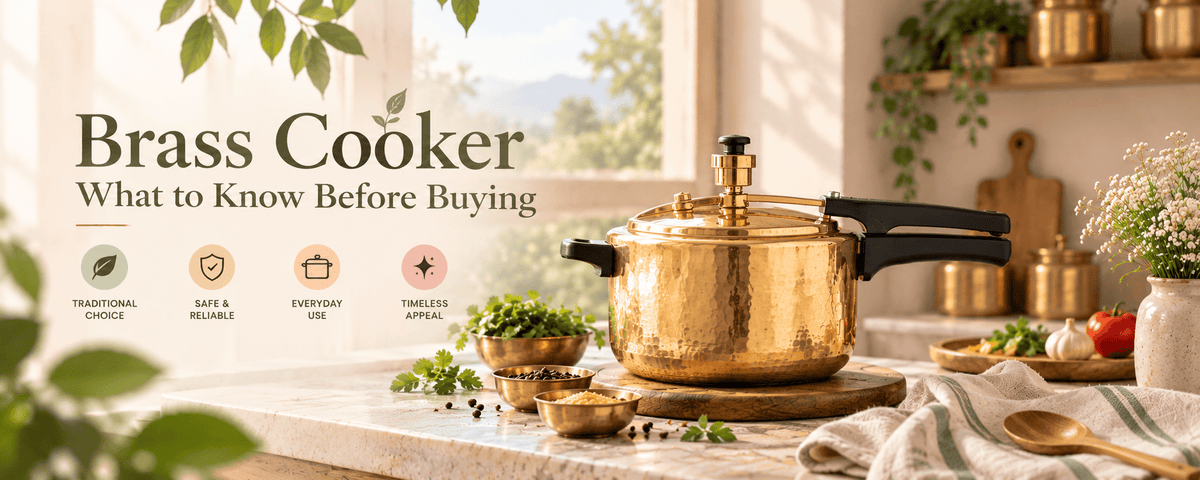
Brass Cooker: What to Know Before Buying Traditional Brass Cookware
A brass cooker brings together the traditional character of Indian metalware and the convenience of pressure cooking. Brass has long been associated with Indian household utensils, craftsmanship, and heritage, and traditional cookware is once again finding a place in modern kitchens.
Explore our collection of brass cookware to discover traditional cooking vessels designed for heritage-inspired kitchens.
However, buying a brass cooker is different from choosing a decorative brass vessel or an open cooking pot. Construction, interior lining, pressure mechanism, capacity, handles, maintenance, and safety features all deserve attention.
If you are considering a brass pressure cooker, this guide explains what to look for before making your choice.
Table of Contents
-
What Is a Brass Cooker?
-
Why Are Brass Cookers Becoming Popular?
-
Brass Cooker vs Traditional Brass Cookware
-
What to Check Before Buying a Brass Cooker
-
Does a Brass Cooker Need Kalai?
-
How to Choose the Right Brass Cooker Size
-
Brass Cooker Buying Checklist
-
How to Use a Brass Cooker Safely
-
How to Clean and Care for a Brass Cooker
-
Why Choose a Royal Stuffs Brass Cooker?
-
Is a Brass Cooker Right for Your Kitchen?
-
Frequently Asked Questions
-
Final Thoughts
What Is a Brass Cooker?

(Handcrafted brass pressure cooker in a soft natural Indian setting)
A brass cooker is a pressure-cooking vessel that incorporates brass into its construction or exterior while providing the design needed for pressure cooking.
Unlike an ordinary brass kadai, degchi, or handi, a pressure cooker operates as a sealed cooking vessel. Its lid, gasket, pressure regulator, and safety mechanism are therefore essential parts of the product.
Not every brass cooker has exactly the same construction. Some products may combine brass with other materials or use an interior lining or protective coating. For this reason, always check the manufacturer's specifications before buying.
For a broader understanding of the material itself, read our guide to What Is Brass?
Why Are Brass Cookers Becoming Popular?
The renewed interest in traditional cookware is not only about appearance. For many households, it is also about reconnecting with Indian craftsmanship and the visual character of heritage kitchenware.
1. Connection to Indian Kitchen Heritage
Brass has been used extensively in Indian household metalware for generations. Cooking vessels, serving utensils, storage containers, and ritual objects have historically been made using different metals according to regional traditions and household practices.
A traditional brass cooker represents an interesting meeting point between this heritage and the convenience of modern pressure cooking. To understand this wider tradition, explore Traditional Indian Metal Utensils: A Journey Through India's Kitchen Heritage.
2. Distinctive Brass Appearance
The warm golden tone of brass looks very different from conventional stainless-steel cookware.
Hand-finished or hammered surfaces can also provide subtle variations in texture, giving the cookware a handcrafted appearance rather than a completely uniform factory-made finish.
3. Artisan Craftsmanship
Traditional Indian metalware is closely connected with skilled craftsmanship. Depending on how a product is made and finished, small variations in texture, shaping, or surface appearance can give individual pieces their character.
For buyers who appreciate handcrafted Indian products, this can be an important part of the appeal.
4. Heritage Meets Everyday Convenience
A pressure cooker is valued for practical cooking convenience, while brass adds a traditional aesthetic.
A brass cooker therefore appeals to people who want to introduce the character of traditional Indian cookware into a modern kitchen. If you are comparing traditional metals for cookware, see our guide to Brass vs Copper vs Kansa.
Brass Cooker vs Traditional Brass Cookware

(Brass pressure cooker beside traditional brass kadai handi and degchi)
A brass cooker should not be confused with ordinary open brass cooking vessels.
| Cookware | Design | Typical Use |
|---|---|---|
| Brass Cooker | Sealed pressure-cooking vessel | Pressure cooking |
| Brass Kadai | Deep open pan | Frying and cooking |
| Brass Degchi | Deep cooking pot | Rice, curries and simmering |
| Brass Handi | Rounded cooking vessel | Traditional cooking |
| Brass Patila | Deep pot | Boiling and general cooking |
| Brass Tawa | Flat cooking surface | Rotis and flatbreads |
The major difference is the pressure-cooking system. Unlike a pressure cooker, a brass kadai is an open cooking vessel designed for direct cooking rather than pressure cooking. A cooker requires additional components such as a properly fitting lid, gasket, pressure regulator, and safety mechanism.
A cooker requires additional components such as a properly fitting lid, gasket, pressure regulator, and safety mechanism.
To explore different traditional vessels, read Brass Cookware Types Explained: Kadai, Degchi, Handi, Tawa & Traditional Cooking Vessels.
What to Check Before Buying a Brass Cooker
Choosing the right brass cooker for cooking requires more than checking its appearance.
1. Construction Quality
Look closely at the body, lid, handles, joints, and overall finishing.
Check that:
-
The lid fits properly
-
Handles are securely attached
-
The body has an even finish
-
Joints appear strong and properly finished
-
There are no cracks or sharp edges
-
Product specifications are clearly provided
A traditional-looking exterior should still be supported by sound construction.
2. Interior Lining or Coating
The cooking surface is one of the most important things to understand.
Brass is primarily an alloy of copper and zinc, and the suitability of a particular brass vessel for food contact depends on its construction and intended use. Traditional utensils may also use an interior lining or coating.
If the cooker has kalai or another protective lining, understand:
-
What material the lining uses
-
Whether the cooking surface is intended for food contact
-
Which foods the manufacturer recommends
-
How the lining should be cleaned
-
Whether abrasive cleaners should be avoided
-
What maintenance is required if the lining becomes worn
A similar-looking exterior does not mean that every brass cooker has the same interior construction.
3. Pressure-Cooking Mechanism
A pressure cooker needs a properly designed pressure system.
Before purchasing, check the:
-
Lid-locking mechanism
-
Gasket or sealing ring
-
Pressure regulator
-
Safety valve
-
Pressure-release system
Do not remove, modify, or replace safety components with unsuitable parts. Use the manufacturer's recommended components and instructions.
4. Handles
Handles should provide a secure and stable grip.
Consider how comfortable the cooker will be to handle when filled and pay attention to the manufacturer's instructions regarding heat exposure, washing, and handling.
5. Finish and Craftsmanship
Hand-hammered surfaces and artisan finishing can give a brass cooker distinctive character.
Minor variations in texture or finish may naturally occur in handcrafted products. However, cracks, loose components, sharp edges, or poorly fitted parts should not be treated as normal craftsmanship.
Does a Brass Cooker Need Kalai?

(Brass pressure cooker with silver-toned Kalai tin-lined interior)
Kalai traditionally refers to tin lining applied to certain copper and brass utensils. It can provide a protective interior surface between food and the underlying metal, depending on the construction and intended use of the vessel.
If you are considering a brass cooker with kalai or another protective lining, ask the seller or manufacturer about:
-
The interior material
-
Food-contact suitability
-
Recommended foods
-
Cleaning instructions
-
Whether abrasive cleaners are prohibited
-
What to do if the lining becomes damaged or worn
This distinction is important because cleaning methods suitable for decorative or unlined brass may not be appropriate for a cooker with a lined cooking surface.
Always follow the product-specific care instructions supplied by the manufacturer. For more information about maintaining traditional metalware, see our guide to cleaning and caring for brass utensils.
How to Choose the Right Brass Cooker Size
Capacity is another important part of choosing a traditional brass cooker.
The best size depends on how much food you normally prepare rather than simply choosing the largest cooker available.
Smaller Capacity
Suitable for individuals, couples, or smaller cooking quantities.
Medium Capacity
A practical option for many family meals and regular household cooking.
Larger Capacity
More suitable for larger households or situations where greater quantities need to be prepared.
Always check the stated capacity and manufacturer's recommended fill level. Never overfill a pressure cooker.
Brass Cooker Buying Checklist
Before purchasing, use this simple checklist:
✓ Construction quality
✓ Interior material
✓ Kalai or protective coating
✓ Pressure mechanism
✓ Gasket and sealing system
✓ Safety components
✓ Handle quality
✓ Capacity
✓ Cleaning requirements
✓ Manufacturer information
✓ Craftsmanship and finish
Comparing these points can help you choose based on actual functionality instead of appearance alone.
How to Use a Brass Cooker Safely

(Brass pressure cooker with properly fitted lid and pressure regulator)
Traditional styling does not replace pressure-cooker safety.
Before using the cooker:
-
Check that the gasket is correctly positioned and in good condition.
-
Ensure pressure-release components are clean and unobstructed.
-
Make sure the lid is correctly fitted.
-
Follow the recommended fill level.
-
Use the cooker only according to the manufacturer's instructions.
-
Never attempt to force the lid open while pressure remains inside.
-
Release pressure according to the manufacturer's recommended method.
-
Regularly inspect the gasket, regulator, and safety components for wear.
If a gasket, regulator, safety valve, or another important component becomes damaged, use the correct manufacturer-approved replacement.
If you are uncertain about the condition or operation of a pressure component, stop using the cooker until it has been checked.
How to Clean and Care for a Brass Cooker
Proper care helps maintain both the appearance and functionality of traditional cookware.
Clean the Exterior Gently
Use a soft cloth or suitable sponge and follow the recommended cleaning method.
Avoid aggressive scrubbing that can unnecessarily damage the surface finish.
Take Extra Care With the Interior
If your cooker has kalai or another protective coating, avoid abrasive cleaning methods unless the manufacturer specifically recommends them.
Cleaning methods designed for unlined brass may not be suitable for a lined cooking surface.
Dry Thoroughly
Dry the cooker after washing, paying particular attention to areas around handles, joints, and removable components.
Store Carefully
Keep the cooker in a dry location.
Avoid placing heavy cookware directly on top of it if doing so could scratch or damage the finish.
Follow Product-Specific Instructions
Generic brass-cleaning advice should never override the instructions supplied with the cooker.
The construction, lining, pressure system, and finish can differ between products.
Why Choose a Royal Stuffs Brass Cooker?
If you are looking for a traditional brass cooker, the details matter just as much as its appearance.
Royal Stuffs brings the visual character of traditional brass cookware into a design intended for practical kitchen use. The Royal Stuffs Handmade Brass Pressure Cooker with Kalai Coating is available in 3L and 5L capacities and features a Kalai-coated interior. Instead of choosing a cooker simply because it has a brass finish, consider its construction, pressure-cooking components, cooking surface, capacity, and care requirements.
Traditional Brass Character
A Royal Stuffs brass cooker brings the warm appearance of brass into the everyday kitchen.
It can appeal to households that appreciate Indian metalware, traditional craftsmanship, and heritage-inspired cookware.
Designed With Practical Use in Mind
A cooker needs to be more than attractive.
Construction, pressure-cooking components, handles, capacity, cooking surface, and safety features all matter. Before purchasing, review the product specifications and understand the lining or coating, recommended use, and care instructions.
A Heritage-Inspired Addition to a Modern Kitchen
Traditional cookware can sit naturally alongside modern kitchen essentials.
A brass cooker can add an element of Indian craftsmanship while still serving a familiar pressure-cooking function.
What Makes It Worth Considering?
A brass cooker can be worth considering if you are looking for:
-
Traditional brass-inspired cookware
-
A distinctive alternative to conventional-looking cookware
-
Heritage-focused Indian craftsmanship
-
A cooker suited to your household requirements
-
Clear specifications and care information
-
Traditional character combined with everyday kitchen functionality
Before You Buy
Make your decision based on construction, interior lining, capacity, pressure mechanism, safety components, handles, and maintenance requirements rather than appearance alone.
Is a Brass Cooker Right for Your Kitchen?
A brass cooker can be a good choice if you appreciate traditional Indian aesthetics while still wanting the familiar convenience of pressure cooking.
It may particularly appeal to people interested in:
-
Traditional Indian metalware
-
Handcrafted products
-
Brass craftsmanship
-
Heritage-inspired kitchenware
-
Traditional cookware with modern functionality
However, the right choice depends on the individual product.
Before buying, evaluate the interior construction, lining or coating, pressure mechanism, gasket, safety components, capacity, handles, and maintenance requirements.
If you enjoy traditional metal cookware, you can also explore our collection of brass kitchenware for other heritage-inspired cooking and serving pieces.
Frequently Asked Questions
Is a brass cooker safe for cooking?
Safety depends on the cooker's construction, cooking surface, pressure system, and safety components. Always use the cooker according to the manufacturer's instructions.
Is a brass cooker made entirely from brass?
Not necessarily. A brass cooker may incorporate other materials or components, including a lining, coating, gasket, regulator, or safety mechanism. Check the product specifications for exact construction details.
What is kalai in a brass cooker?
Kalai traditionally refers to a tin lining used on certain brass and copper utensils. Its purpose can be to provide a protective interior surface, depending on the vessel's construction.
Can I cook acidic foods in a brass cooker?
Do not assume that all brass cookware is suitable for all foods. Check the manufacturer's recommendations, particularly when the cooker has a lining or protective coating.
How should I clean a brass cooker?
Follow the manufacturer's cleaning instructions. Use gentle cleaning methods and avoid abrasive products, especially when the cooking surface has kalai or another protective coating.
What size brass cooker should I buy?
Choose the capacity according to your household size and normal cooking quantities. Always follow the manufacturer's stated capacity and fill limits.
Does brass change colour over time?
Yes. Brass can naturally develop changes in surface appearance and patina over time. The rate depends on exposure, handling, moisture, and cleaning.
Is a brass cooker the same as a brass kadai?
No. A brass kadai is an open cooking vessel, while a pressure cooker is a sealed vessel that uses pressure and requires additional safety components.
What should I check before buying a brass cooker?
Look at construction quality, interior material, kalai or protective coating, pressure mechanism, gasket, safety components, handles, capacity, maintenance requirements, craftsmanship, and manufacturer information.
Final Thoughts

(Traditional brass cookware bringing Indian heritage into a modern kitchen)
A brass cooker represents an interesting meeting point between Indian metalware heritage and the convenience of pressure cooking.
Its warm appearance and handcrafted character can make it appealing to households that appreciate traditional cookware. But when buying one, it is important to look beyond the golden finish.
Understand the construction, cooking surface, kalai or protective lining, pressure mechanism, capacity, safety components, and maintenance requirements.
The best choice is a properly constructed cooker that suits your cooking needs and comes with clear information about its use and care.
Traditional-inspired cookware does not have to remain a decorative reminder of the past. With the right construction and responsible use, it can become part of the everyday Indian kitchen while preserving the visual character of traditional metalware.
Read more
Copper Kadai for Cooking: Benefits, Uses & Buying Guide
Discover the traditional appeal of copper kadai for Indian cooking. Learn about its uses, benefits, key features, care requirements and what to consider before choosing one for your kitchen.
Read more
Copper Bowls: Uses, Benefits, Care & Traditional Indian Kitchen Practices
Discover the uses, benefits and care of copper bowls while exploring their place in traditional Indian kitchens. Learn how to choose, use and maintain handcrafted copper bowls for everyda...
Read more