
Article: What Is Brass? A Complete Beginner’s Guide to Brass Metal, Uses & Indian Heritage

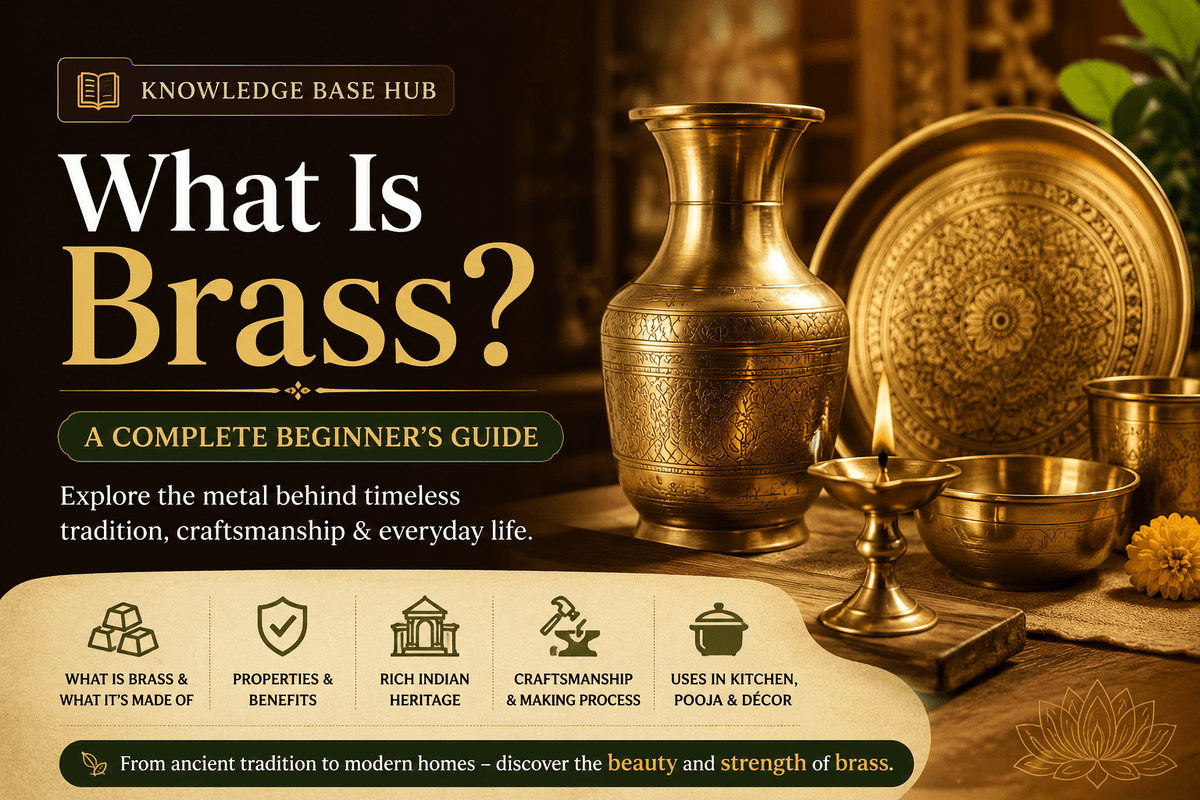
What Is Brass? A Complete Beginner’s Guide to Brass Metal, Uses & Indian Heritage
What Is Brass?
Imagine an old Indian kitchen.
A brass lota sits quietly on a shelf. A polished brass diya catches the morning sunlight. Nearby, traditional brass utensils have been used for years, carrying with them not just food and water, but memories of generations.
That familiar golden metal is brass.
But what exactly is brass? Why does it have that distinctive golden colour? How is it different from copper or bronze? And why has this metal remained popular in Indian homes, temples, kitchens, and handicrafts for centuries?
In simple terms, brass is an alloy made primarily from copper and zinc. By changing the proportions of these metals, manufacturers and artisans can create different types of brass with different levels of strength, hardness, colour, and workability.
But brass is much more than a combination of two metals.
It is a material that sits at the intersection of craftsmanship, functionality, design, and heritage.
Let's start from the beginning.
What Is Brass Made Of?

(Brass alloy made from copper and zinc with handcrafted brass vessel)
The simplest answer to “What is brass made of?” is:
Copper + Zinc = Brass
Copper is the primary component, while zinc is added to modify the properties of the material.
The exact proportions can vary. This is important because not every brass product is made from exactly the same composition.
Changing the copper-to-zinc ratio can influence characteristics such as:
-
Colour
-
Strength
-
Hardness
-
Workability
-
Corrosion resistance
-
Machinability
This flexibility is one of the reasons brass has such a wide range of applications.
A decorative brass object may require a different composition or finishing approach than an industrial brass component.
So when someone simply says “brass,” they are referring to a family of copper-based alloys, rather than one single fixed formula.
Is Brass a Metal or an Alloy?
This is one of the easiest things to get confused about.
Brass is an alloy, not a pure metal.
A pure metal consists primarily of one metallic element. An alloy is created by combining elements to achieve a useful combination of properties.
For example:
Copper → pure metal
Zinc → pure metal
Copper + Zinc → brass alloy
This process allows brass to have characteristics that differ from those of pure copper or pure zinc.
That is why brass can be strong, workable, visually attractive, and suitable for so many different applications.
Why Does Brass Look Golden?
One of the first things people notice about brass is its colour.
Unlike copper, which has a reddish-orange appearance, brass typically has a warm yellow or golden tone.
The exact shade depends on the composition of the alloy.
Some brass can appear:
-
Bright golden yellow
-
Pale yellow
-
Warm gold
-
Reddish-gold
-
Deep golden brown
A freshly polished brass object can have an almost jewellery-like shine.
Over time, however, brass may become darker or develop a natural patina. This happens because the surface reacts with oxygen, moisture, and other environmental factors.
For some people, that aged appearance is part of brass's charm.
For others, polishing brings back the bright golden finish they prefer.
A Brief Journey of Brass Through Indian Heritage

(Traditional Indian brass craftsmanship in an artisan workshop)
Brass isn't a new material discovered for modern homes.
It has a long association with Indian craftsmanship and everyday life.
Across different parts of India, metalworkers have traditionally transformed brass into objects used for cooking, serving, worship, decoration, and ceremonies.
Think of the objects commonly associated with traditional Indian households:
Brass diya.
Brass thali.
Brass lota.
Brass bell.
Brass kalash.
Brass pooja utensils.
Brass decorative vessels.
These aren't simply objects made from metal.
Many carry cultural meaning.
A diya represents light. A kalash can be associated with auspiciousness. Traditional serving vessels can connect everyday meals with generations of family traditions.
India's brass craftsmanship has also developed into a major handicraft tradition, with Moradabad in Uttar Pradesh being particularly well known for its brass and metalware industry.
Explore the [History of Brassware in India] to discover how brass became an important part of India's traditional metalcraft.
Artisans use techniques such as casting, hammering, engraving, embossing, polishing, and other finishing methods to transform raw metal into functional and decorative objects.
This is where brass becomes more than a material.
It becomes craft.
How Is a Brass Object Made?

(Indian artisan shaping and engraving a handcrafted brass vessel)
Have you ever wondered how a plain piece of metal becomes a beautifully decorated brass bowl or diya?
The exact process varies depending on the product and craft tradition, but brass objects may go through several stages.
1. Selecting the Brass
The appropriate brass alloy is selected according to the intended product and manufacturing process.
2. Shaping the Metal
Depending on the object, brass may be cast, pressed, hammered, formed, or machined.
3. Adding Details
Traditional artisans may add decorative details through techniques such as:
-
Engraving
-
Embossing
-
Etching
-
Hammering
-
Carving
-
Decorative finishing
4. Polishing
The surface is polished to achieve the desired appearance.
A highly polished brass object can have a bright reflective finish, while some products may intentionally retain a more antique or aged appearance.
5. Quality Checking
Finally, the product is inspected for shape, finish, detailing, and overall quality before reaching the customer.
This process explains why two brass objects that look similar at first glance can differ significantly in craftsmanship.
7 Fascinating Properties of Brass
So why has brass remained useful for so long?
Here are some of its most important characteristics.

(Polished and engraved brass objects showing the durability and beauty of brass)
1. Brass Is Durable
Brass can be highly durable when the correct alloy and construction are used for the intended application.
That makes it suitable for products designed to be used repeatedly and preserved for years.
2. Brass Is Highly Workable
Many brass alloys are relatively easy to shape and machine.
This is particularly useful for artisans because the material can be transformed into intricate forms and decorative designs.
That workability is one reason brass has such a strong connection with handicrafts.
3. Brass Has a Distinctive Appearance
Few materials have the same warm golden character as brass.
It can make a traditional kitchen feel more authentic, add warmth to a dining table, or give a decorative object a timeless appearance.
4. Brass Has Good Corrosion Resistance
Brass generally offers good resistance to corrosion compared with many other metals.
However, corrosion resistance doesn't mean that brass will remain completely unchanged.
Its surface can naturally darken and develop patina over time.
5. Brass Conducts Heat
Because brass contains a significant amount of copper, it has useful thermal conductivity.
This property contributes to its use in certain kitchenware and engineering applications.
However, the suitability of a brass product for cooking depends on its specific composition, construction, and manufacturer's instructions.
6. Brass Is Recyclable
Brass can be recycled and reused.
This gives the material an important advantage: a well-made brass object can have a long life, and the material itself can potentially continue through multiple cycles of use.
7. Brass Ages Beautifully
This may be one of its most distinctive characteristics.
Instead of simply becoming “old,” brass can develop a deeper, darker appearance known as patina.
Some people prefer freshly polished brass.
Others love the character of aged brass.
Either way, the changing surface is part of the material's identity.
Want to explore these characteristics specifically in traditional kitchenware? Read our guide to the [Benefits of Brass Utensils].
For traditional serving and dining, explore our [Brass Dinnerware Collection].
Where Is Brass Used?
Brass is far more versatile than many people realize.
Brass in Indian Kitchenware

(Traditional brass cookware and dinnerware in an Indian kitchen)
Brass has a long history in traditional Indian kitchens.
It can be found in:
-
Cooking vessels
-
Serving bowls
-
Plates
-
Glasses
-
Tumblers
-
Containers
-
Traditional serving utensils
Today, brass kitchenware is also finding its way into modern homes where people want to combine traditional materials with contemporary lifestyles.
For those exploring traditional Indian kitchenware, the Royal Stuffs Brass Cookware Collection can be a natural next step.
Brass in Pooja

(Traditional brass diya and pooja utensils arranged in an Indian prayer setting)
Brass has a particularly strong presence in Indian पूजा traditions.
Common brass pooja products include:
-
Diyas
-
Pooja thalis
-
Bells
-
Kalash
-
Aarti lamps
-
Incense holders
-
Pooja containers
The golden appearance of brass also complements the visual symbolism of traditional worship spaces.
Explore our collection of [Brass Pooja Items] for traditional pieces used in Indian पूजा and devotional settings.
Brass in Home Décor

(Handcrafted brass home décor in a modern Indian living room)
Modern interior design has given brass a new life.
Today, brass is used for:
-
Wall décor
-
Urli bowls
-
Decorative trays
-
Lamps
-
Figurines
-
Vases
-
Table accents
-
Architectural details
A brass object can work equally well in a traditional Indian interior or a contemporary space.
Explore the [Brass Home Décor Collection] for handcrafted pieces that bring the warmth of traditional brass into contemporary interiors.
Brass in Musical Instruments
Brass also plays an important role in music.
Instruments such as trumpets, trombones, and French horns commonly use brass alloys because of their acoustic and physical properties.
So the same broad family of material found in a traditional Indian decorative object can also contribute to the sound of an orchestra.
Brass in Hardware and Industry
Brass is also used in practical applications such as:
-
Door handles
-
Locks
-
Screws
-
Plumbing fittings
-
Electrical components
-
Machine parts
-
Industrial components
This shows that brass isn't merely a decorative material.
It is also an important engineering material.
Brass vs Copper vs Bronze
Three names often appear together: brass, copper, and bronze.

(Brass copper and bronze vessels showing their different metal colours)
But they are different materials.
| Feature | Brass | Copper | Bronze |
|---|---|---|---|
| Type | Alloy | Pure metal | Copper-based alloy |
| Main elements | Copper + Zinc | Copper | Traditionally Copper + Tin |
| Typical colour | Yellow-golden | Reddish-orange | Brownish/golden |
| Common uses | Décor, utensils, hardware, instruments | Electrical, plumbing, cookware | Sculptures, bearings, marine & industrial applications |
| Appearance | Warm golden | Reddish metallic | Deeper brown/golden |
The easiest beginner-friendly distinction is:
Brass = Copper + Zinc
Bronze = Traditionally Copper + Tin
Copper = Copper
Of course, modern commercial alloys can contain additional elements, so these formulas are simplified descriptions rather than rules covering every alloy.
If you're specifically comparing these materials for traditional kitchenware, read our detailed guide to [Brass vs Copper Utensils].
Why Does Brass Turn Black or Dark?

(Natural patina developing on an aged brass vessel)
If you've ever owned a brass object, you've probably noticed something interesting.
It doesn't always stay shiny.
With time, brass can become darker because its surface reacts with the surrounding environment.
Factors such as:
-
Oxygen
-
Moisture
-
Humidity
-
Oils from handling
-
Pollutants
can influence how quickly the surface changes.
This can create a darker layer or patina.
It doesn't automatically mean the brass is fake or damaged.
In many cases, it is simply the natural aging of the surface.
If you prefer the original shine, appropriate cleaning and polishing can help restore the appearance.
For practical maintenance tips, see our complete guide on [How to Clean Brass Utensils].
How Can You Tell If Brass Is Good Quality?
When buying brass products, appearance alone doesn't tell the entire story.
Consider:
Material
Ask whether the product is made from brass and, where relevant, whether the seller provides composition or material information.
Craftsmanship
Look closely at:
-
Joints
-
Edges
-
Decorative details
-
Surface finish
-
Symmetry
-
Engraving
Weight and Construction
Depending on the product, a well-constructed brass object can have a substantial feel.
However, weight alone should never be treated as proof of quality.
Finish
Look for a consistent finish appropriate to the product—whether polished, matte, antique, or handcrafted.
Intended Use
Always check whether the item is designed for food contact, cooking, decoration, or religious use.
This is particularly important because different brass products may have different linings, finishes, or care requirements.
How to Care for Brass

(Cleaning and polishing a traditional brass vessel with a soft cloth)
Good brass care doesn't need to be complicated.
Simple Brass Care Tips
-
Dust brass objects regularly with a soft cloth.
-
Avoid harsh abrasive cleaners unless specifically recommended.
-
Keep brass products dry after cleaning.
-
Follow the manufacturer's instructions for lined products.
-
Use appropriate brass-cleaning methods when polishing is required.
-
Store decorative brass objects in a dry environment.
Remember: not every brass object should be cleaned in exactly the same way.
A decorative antique-style item may require different care from a food-contact brass utensil.
Is Brass Still Relevant in Modern Homes?
Absolutely.
Perhaps that's the most interesting thing about brass.
It has existed alongside generations of traditional households, yet it hasn't disappeared with modernization.
Instead, it has adapted.
A brass diya can sit beside a minimalist interior.
A brass serving bowl can be used on a contemporary dining table.
A traditional brass urli can become a modern centrepiece.
A handcrafted brass wall accent can transform an otherwise simple room.
This ability to bridge traditional craftsmanship and modern design is one of brass's greatest strengths.
Frequently Asked Questions About Brass
What is brass?
Brass is a copper-based alloy made primarily by combining copper and zinc.
What is brass made of?
Brass is primarily made from copper and zinc. The proportions can vary depending on the type of brass and its intended application.
Is brass a pure metal?
No. Brass is an alloy rather than a pure metal.
Is brass the same as copper?
No. Copper is a pure metal, while brass is primarily a copper-zinc alloy.
Is brass the same as bronze?
No. Brass is primarily copper and zinc, while traditional bronze is primarily copper and tin.
Why does brass turn dark?
Exposure to air, moisture, handling, and environmental conditions can cause the brass surface to oxidize and develop patina.
Can brass be recycled?
Yes. Brass is a recyclable alloy and can be recovered and reused.
Why is brass popular in Indian handicrafts?
Brass combines an attractive golden appearance with useful workability and durability, making it suitable for traditional techniques such as casting, engraving, hammering, and polishing.
Can brass be used for kitchenware?
Brass has a long history in traditional kitchenware. However, always check the specific product's material, lining, finish, and manufacturer's intended-use instructions before using it for cooking or food storage.
How do I keep brass shiny?
Regular dusting, suitable cleaning, and appropriate polishing can help maintain the shine. Follow the care instructions provided with your specific brass product.
Final Thoughts: Brass Is a Material With a Story
So, what is brass?
Scientifically, it is a copper-based alloy containing zinc.
But that simple definition doesn't tell the whole story.
Brass has been shaped into household vessels, temple objects, musical instruments, architectural details, decorative pieces, and countless other products.
In India, it also carries something less tangible: a connection to craftsmanship and heritage.
Every engraved surface, polished curve, hammered detail, and traditional vessel reflects the remarkable ability of artisans to turn a simple metal alloy into something functional and beautiful.
That is perhaps why brass continues to have a place in modern homes.
It isn't simply an old material.
It is an old material that continues to find new ways to belong.
From understanding what brass is to learning how to choose, use, and care for it, this is only the beginning.
Explore the Royal Stuffs Knowledge Base to discover more about Indian metalware, brass cookware, traditional utensils, craftsmanship, and the stories behind India's timeless materials.
Read more
What Is Copper? A Complete Beginner’s Guide to Copper Metal
Discover what copper is, how it is made, its unique properties, traditional uses, and its enduring connection to Indian craftsmanship in this beginner-friendly guide.
Read more