

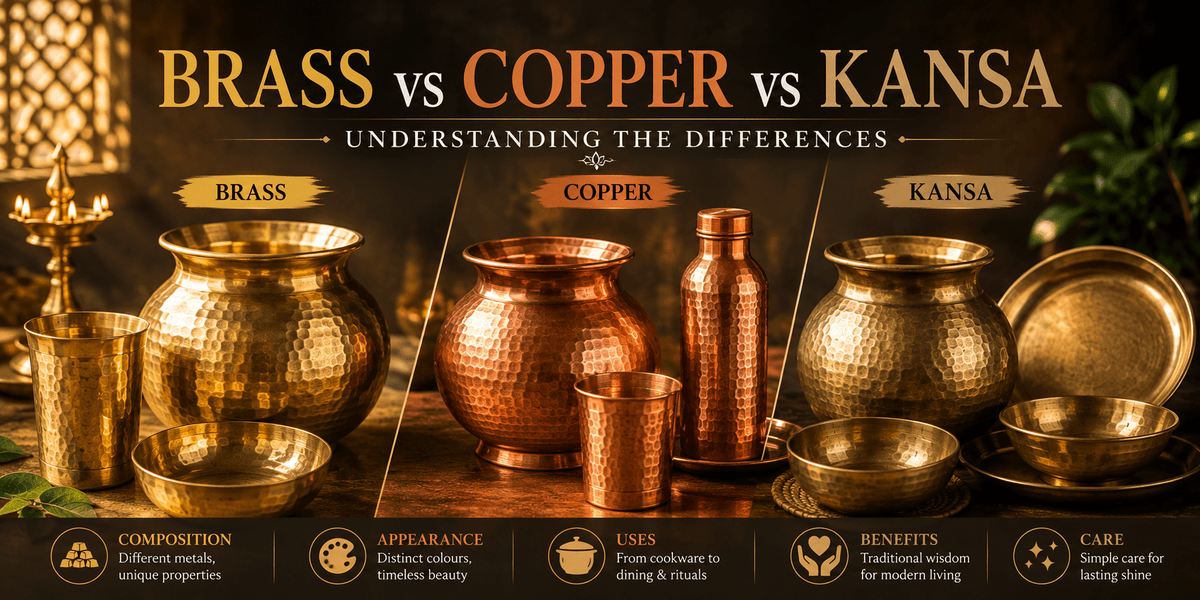
Brass vs Copper vs Kansa: Understanding the Differences
Three metals. Three distinctive colours. Three different places in India's long tradition of craftsmanship.
Brass shines golden. Copper carries a warm reddish glow. Kansa has a deeper golden-brown character.
But when you're choosing a traditional vessel, thali, utensil, pooja item or decorative piece, appearance is only the beginning.
What actually makes brass, copper and Kansa different?
And more importantly, which one should you choose?
If you've already explored our individual guides to [What Is Brass? A Complete Beginner's Guide to Brass Metal], [What Is Copper? A Complete Beginner's Guide to Copper Metal], and [What Is Kansa? A Complete Beginner's Guide to Kansa Metal], this article takes the next step.. Instead of explaining each metal from scratch, we'll put them side by side and look at where they differ in composition, appearance, traditional uses, care and everyday applications.
Brass vs Copper vs Kansa at a Glance

(Brass copper and Kansa vessels showing their different colours and textures)
| Feature | Brass | Copper | Kansa |
|---|---|---|---|
| Material type | Copper-based alloy | Pure metal | Traditional copper-based alloy |
| Common alloying element | Zinc | — | Traditionally tin |
| Typical colour | Yellow-golden | Reddish-orange | Golden-brown |
| Traditional Indian uses | Pooja, cookware, décor, servingware | Vessels, drinkware, cookware, pooja | Thalis, bowls, glasses, servingware |
| Visual character | Bright and warm | Rich and reddish | Muted and earthy |
| Common heritage association | Indian décor & ritual objects | Traditional vessels & household use | Traditional dining & tableware |
Note: Exact alloy composition and terminology can vary between products, manufacturers and regional craft traditions. Always check product specifications when composition is important.
The First Difference: What Are They Made Of?

(Traditional brass copper and Kansa materials displayed on an artisan workbench)
This is the fundamental difference.
Brass is primarily a copper-zinc alloy.
Copper is a pure metal.
Kansa is traditionally associated with copper-tin alloy and metalware traditions.
You don't need to memorize complex metallurgy to tell them apart. Think of it this way:
Copper is the base metal. Brass and Kansa are traditional copper-based alloy families with different compositions and characteristics.
If you want the full explanation of each material, you can explore:
-
[What Is Brass? A Complete Beginner's Guide to Brass Metal]
-
[What Is Copper? A Complete Beginner's Guide to Copper Metal]
-
[What Is Kansa? A Complete Beginner's Guide to Kansa Metal]
This comparison article is about what happens when you put all three side by side.
The Easiest Difference to See: Colour
If you placed three freshly finished vessels on a table, colour would probably be the first thing you notice.
Brass: Bright Golden
Brass generally has a yellow-golden appearance.
Its polished surface can look bright and luxurious, while antique or aged finishes can create deeper tones.
This makes brass particularly popular for Indian:
-
Diyas
-
Lamps
-
Pooja items
-
Decorative objects
-
Servingware
Copper: Reddish-Orange
Copper has a much more recognizable reddish-orange tone.
Its warm colour makes it particularly distinctive among traditional household metals.
Kansa: Warm Golden-Brown
Kansa usually sits visually between the brighter appearance of brass and the reddish character of copper.
It tends toward a muted golden-brown or earthy golden tone, depending on composition, finish and age.
Quick visual guide
Brass → 🟡 Golden
Copper → 🟠 Reddish-orange
Kansa → 🟤 Golden-brown
Of course, lighting, polishing and surface treatments can change how a metal appears.
Brass vs Copper vs Kansa for Traditional Indian Dining
This is one of the most useful ways to compare them.

(Brass copper and Kansa traditional Indian dining vessels arranged side by side)
Brass for Dining
Brass has long been used for traditional Indian household vessels, servingware and cookware.
Its golden appearance also makes it attractive for festive dining and traditional presentation.
Best suited when you want:
A bright, classic Indian-metal aesthetic.
Copper for Dining
Copper vessels have a strong place in Indian household traditions.
You may see copper used for:
-
Water vessels
-
Glasses
-
Bottles
-
Plates
-
Bowls
-
Cookware
However, suitability depends on the specific product. Some copper cookware is constructed or lined specifically for particular culinary uses.
Best suited when you want:
The distinctive look and heritage of copper, with the product's construction matched to its intended use.
Kansa for Dining
This is where Kansa has a particularly strong identity.
Kansa has traditionally been associated with:
-
Thalis
-
Bowls
-
Plates
-
Glasses
-
Serving vessels
A Kansa thali can create an unmistakably traditional Indian dining experience.
Explore more traditional tableware through the [Brass Dinnerware Collection].
Best suited when you want:
Heritage-inspired dining and traditional handcrafted tableware.
Which Metal Is Best for a Traditional Thali?
If your priority is a traditional Indian thali, Kansa deserves special attention.
Its warm, understated appearance works beautifully with traditional food presentation.
A typical Kansa dining setup may include:
-
One large thali
-
Several small bowls
-
A drinking glass
-
Serving pieces
Brass can also create a beautiful traditional dining setup, while copper has its own distinctive appeal.
But the choice ultimately comes down to the specific product, intended use, construction and personal preference.
Brass vs Copper vs Kansa for Pooja

(Traditional brass copper and Kansa vessels arranged in an Indian pooja setting)
Traditional Indian pooja objects are another area where these metals overlap.
Brass
Brass is especially common in:
-
Diyas
-
Pooja thalis
-
Bells
-
Kalash
-
Lamps
-
Decorative devotional objects
Discover more traditional pieces in our [Brass Pooja Collection].
Its golden appearance naturally complements traditional shrine settings.
Copper
Copper is also traditionally used for:
-
Kalash
-
Pooja vessels
-
Water containers
-
Ritual accessories
Its reddish tone gives it a distinctive visual character.
Kansa
Kansa and related copper-based alloy traditions can also appear in traditional cultural and ritual objects, including bells and other handcrafted pieces.
There isn't one universally "best" metal for pooja. Regional traditions, the specific ritual and personal practice all matter.
Brass vs Copper vs Kansa for Home Décor

(Brass copper and Kansa decorative vessels in a contemporary Indian living room)
Now let's move away from function and talk about aesthetics.
Because these three metals can completely change the mood of an interior.
Choose Brass for a Classic Golden Look
Brass works particularly well if you want:
-
Golden warmth
-
Traditional luxury
-
Ornate detailing
-
A classic Indian aesthetic
Think brass lamps, diyas, trays, wall décor and decorative vessels.
Explore the [Brass Home Décor Collection] for handcrafted pieces that bring traditional Indian metalwork into contemporary interiors.
Choose Copper for Warm Earthy Character
Copper brings:
-
Reddish warmth
-
Rustic character
-
Natural metallic depth
-
A more earthy appearance
It works beautifully with wood, neutral colours and natural materials.
Choose Kansa for Understated Heritage
Kansa has a more muted and grounded appearance.
It works particularly well when you want:
-
Traditional character
-
Subtle metallic warmth
-
Handcrafted aesthetics
-
Heritage-inspired tableware
How Do Brass, Copper and Kansa Age?
One fascinating thing about traditional metals is that they don't necessarily remain exactly the same throughout their lifetime.
Their surfaces can change with:
-
Air exposure
-
Moisture
-
Handling
-
Cleaning
-
Polishing
-
Age
Brass
Brass can gradually develop a darker, more antique appearance.
Copper
Copper can develop deeper brown tones and, depending on environmental conditions, greenish patina.
Kansa
Kansa can develop deeper golden-brown tones and a more aged surface character.
This doesn't automatically mean that the object is damaged.
For many people, these changes are part of what makes traditional metalware interesting.
A new-looking vessel tells you what it looked like when it was made. An aged vessel can tell you something about how it was used and cared for.
Which Is Easier to Maintain?

(Gentle care and polishing of traditional brass copper and Kansa utensils)
All three require appropriate care, but the right method depends on the specific finish and intended use.
| Metal | General Care Consideration |
|---|---|
| Brass | Gentle cleaning and appropriate polishing |
| Copper | Regular maintenance if you want a brighter finish |
| Kansa | Gentle cleaning and thorough drying |
Avoid assuming that one cleaning method works for all three.
A highly polished product, antique-finished product and untreated handcrafted vessel can require different care.
Always follow the manufacturer's instructions first.
Learn more about proper maintenance in our guides to [How to Clean Brass Utensils], [How to Clean Copper Utensils], and [How to Clean Kansa Utensils].
Which Metal Is More Durable?
This is another question where there isn't a simple winner.
A well-made brass, copper or Kansa object can remain useful for many years.
But durability depends on more than the material.
Consider:
-
Thickness
-
Construction
-
Alloy composition
-
Manufacturing technique
-
Intended use
-
Frequency of use
-
Maintenance
A beautifully crafted vessel made for long-term use can outlast a poorly constructed one regardless of whether it is brass, copper or Kansa.
That's why craftsmanship matters as much as material.
Brass vs Copper vs Kansa: Which Should You Choose?
Here's the simplest decision guide.
Choose Brass if you want:
-
Golden traditional décor
-
Pooja items
-
Diyas and lamps
-
Traditional decorative pieces
-
Classic Indian aesthetics
-
Certain types of cookware and servingware
Choose Copper if you want:
-
Copper water vessels
-
Traditional copperware
-
Reddish-orange metallic aesthetics
-
Copper cookware designed for appropriate culinary use
-
Traditional ritual vessels
Choose Kansa if you want:
-
Traditional thalis
-
Kansa bowls
-
Heritage dining
-
Traditional servingware
-
Warm golden-brown handcrafted aesthetics
The important point is that "best" depends on purpose.
There is no reason to choose copper when you actually want the look of brass. And there's no reason to choose brass when what you're really looking for is a traditional Kansa thali.
What About Health Benefits?
This is an area where you should be careful.
Traditional Indian metalware is often promoted online with broad claims about "detoxification," "healing," or guaranteed health benefits.
Those claims shouldn't automatically be treated as scientific facts.
The properties of the material are real, but the health effects of using a particular utensil depend on factors such as composition, surface treatment, food type, contact time and product construction.
So when choosing brass, copper or Kansa for food use, prioritize:
-
Verified material information
-
Food-contact suitability
-
Proper construction
-
Manufacturer guidance
-
Correct cleaning and maintenance
This gives readers useful information without making exaggerated health claims.
Brass vs Copper vs Kansa: Sustainability
There is another reason traditional metalware continues to attract attention: longevity.
A well-made metal utensil can be used repeatedly for years rather than being replaced frequently.
That can make long-lasting metalware appealing to people trying to move away from disposable household products.
Copper and copper-based alloys can also be recycled.
However, sustainability isn't simply about choosing a particular metal.
It also depends on:
-
Material sourcing
-
Manufacturing
-
Product lifespan
-
Maintenance
-
Reuse
-
End-of-life recycling
The most meaningful advantage is often simple:
Use a well-made product for a long time.
A Simple Decision Table
| If your priority is... | Consider |
|---|---|
| Bright golden décor | Brass |
| Traditional diyas & pooja items | Brass |
| Reddish-orange metal aesthetic | Copper |
| Traditional copper vessels | Copper |
| Traditional Indian thali | Kansa |
| Heritage dining | Kansa |
| Warm golden-brown tableware | Kansa |
| Traditional Indian craftsmanship | All three |
The Real Difference Isn't Just the Metal
At first glance, this seems like a question about chemistry.
But when you buy traditional Indian metalware, you're choosing much more than a material.
You're also choosing:
Craftsmanship.
Purpose.
Design.
Maintenance.
Tradition.
A brass diya, copper vessel and Kansa thali may all be made from copper-based metal traditions, but they can play completely different roles in an Indian home.
That's what makes the comparison interesting.
Frequently Asked Questions
What is the main difference between brass, copper and Kansa?
Copper is a pure metal, while brass and Kansa are traditional copper-based alloy/metalware traditions associated with different alloying elements. Their appearance and traditional uses also differ.
Which is better, brass or copper?
Neither is universally better. The right choice depends on the product and intended use.
Is Kansa better than brass?
Kansa and brass have different characteristics and traditional applications. Kansa is particularly associated with traditional dining, while brass is widely used for pooja, décor and household objects.
Which metal is best for a Kansa thali?
Kansa is specifically associated with traditional Kansa thalis. When purchasing one, check the product's material and food-contact specifications.
Which has the best colour: brass, copper or Kansa?
This is subjective. Brass is generally yellow-golden, copper reddish-orange, and Kansa generally golden-brown.
Do all three metals change colour over time?
Yes. Brass, copper and Kansa can all develop changes in surface appearance through age, oxidation, handling and polishing.
Can all three be used for cooking?
Not necessarily. Cooking suitability depends on the specific product's construction and manufacturer instructions.
Which one is best for home décor?
Brass is excellent for bright golden traditional décor, copper for warmer reddish tones, and Kansa for a more muted heritage aesthetic.
Final Thoughts
Brass, copper and Kansa aren't competing versions of the same thing.
They're three different materials and traditions with their own visual identities, applications and cultural histories.
Brass brings golden warmth.
Copper brings reddish character.
Kansa brings understated golden-brown heritage.
Once you understand these differences, choosing traditional metalware becomes much easier.
And instead of asking:
"Which metal is the best?"
Ask:
"Which metal is best for what I want to use it for?"
That's the question that turns a simple purchase into a more informed choice—and helps keep India's traditional metalcraft relevant in modern homes.
Read more
What Is Kansa? A Complete Beginner’s Guide to Kansa Metal
Discover what Kansa is, what it is made of, its unique characteristics, traditional uses, craftsmanship, and enduring importance in Indian dining and heritage.
Read more
Traditional Indian Metal Utensils: A Journey Through India's Kitchen Heritage
Discover the rich heritage of traditional Indian metal utensils, from thalis and lotas to brass, copper and Kansa vessels. Explore their uses, craftsmanship and enduring place in modern Indian kitc...
Read more