

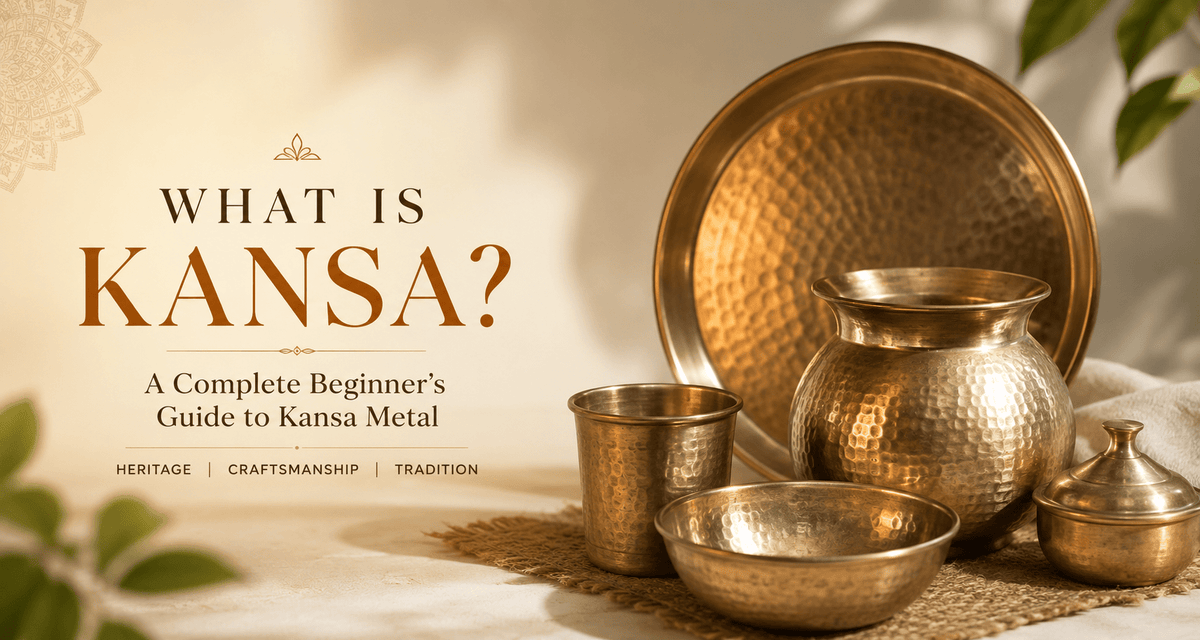
What Is Kansa? A Complete Beginner’s Guide to Kansa Metal
What Is Kansa?
Imagine sitting down for a traditional Indian meal.
Instead of a modern stainless-steel plate, your food is served on a warm, golden-brown metal thali. Small bowls sit neatly around the plate, each carrying a different part of the meal. The surface has a subtle handcrafted texture, and the metal has a character that becomes more beautiful with age.
That metal may be Kansa.
But what is Kansa, and why has this traditional metal remained part of Indian households for generations?
Kansa is a traditional Indian copper-based alloy commonly associated with copper and tin. It is widely connected with traditional Indian utensils, thalis, bowls, glasses, serving vessels, bells, and other handcrafted objects.
Unlike copper, which is a pure metal, Kansa is an alloy. And unlike brass, which is primarily made from copper and zinc, traditional Kansa is generally associated with copper-tin alloy traditions.
But Kansa is more than its composition.
Its story brings together Indian metallurgy, artisan craftsmanship, traditional dining, cultural heritage, and the growing modern interest in sustainable and long-lasting products.
Let's explore Kansa from the very beginning.
What Is Kansa Metal Made Of?

(Traditional Kansa vessel with copper and tin materials on an artisan workbench)
At its simplest, Kansa is a copper-based alloy traditionally associated with copper and tin.
To understand the base metal behind many traditional Indian alloys, explore our beginner's guide to [What Is Copper? A Complete Beginner’s Guide to Copper Metal].
Copper forms the main foundation, while tin changes the characteristics of the resulting metal.
However, there is an important detail to understand.
The term Kansa is used differently across regions and craft traditions, and the exact composition of products sold as Kansa can vary.
That means you shouldn't assume that every Kansa product has exactly the same formula.
When purchasing Kansa utensils, especially products intended for food contact, it is always better to check the manufacturer's material and product specifications.
A simple way to understand traditional metals:
-
Copper → a pure metal
-
Brass → primarily copper + zinc
-
Bronze → a broad family of copper-based alloys, traditionally copper + tin
-
Kansa → a traditional Indian copper-tin alloy/metalware tradition
This simple comparison makes it easier to understand where Kansa fits into the larger story of Indian metalcraft.
If you're curious about another important copper-based alloy, read [What Is Brass? A Complete Beginner’s Guide to Brass Metal].
Is Kansa the Same as Bronze?

(Traditional Kansa and bronze vessels showing their different metal appearances)
This is where things can get confusing.
You will often see Kansa described as a type of traditional bronze or bell metal.
The reason is that bronze is a broad category of copper-based alloys, while Kansa is a traditional Indian term associated with particular copper-tin alloy traditions.
So, while the terms are closely related, Kansa and bronze should not automatically be treated as identical in every context.
Regional terminology, historical practices, alloy composition, and manufacturing methods can all influence how these terms are used.
If you're buying a Kansa product, the safest approach is to look at the specific material information provided by the manufacturer rather than relying only on the name.
Why Does Kansa Have a Golden-Brown Colour?

(Close-up of a Kansa vessel showing its warm golden-brown colour and natural texture)
One of the first things people notice about Kansa is its appearance.
Copper has a distinctly reddish-orange colour.
Brass usually has a brighter yellow-golden appearance.
Kansa, on the other hand, often has a deeper, warmer golden-brown or muted golden appearance.
Its final colour can depend on several factors, including:
-
Alloy composition
-
Surface finish
-
Polishing
-
Age
-
Oxidation
-
Crafting technique
A freshly polished Kansa thali can look elegant and luminous, while an older piece may develop a deeper, more antique character.
This changing appearance is part of the charm of traditional metalware.
Kansa doesn't necessarily have to look perfectly new to look beautiful.
The Story of Kansa in Indian Heritage

(Indian artisan crafting traditional Kansa utensils in a heritage workshop)
To understand Kansa, you have to look beyond the kitchen.
India has a remarkably long history of metalworking. Across centuries, artisans developed techniques for working with copper and copper-based alloys to create everything from household vessels to ritual objects and sculptures.
Kansa became closely associated with traditional household utensils and dining.
A Kansa thali wasn't simply a plate.
It could represent an entire dining system:
-
A large plate
-
Small bowls
-
Serving vessels
-
Drinking glasses
-
Containers
These objects were designed to be used repeatedly, cleaned, maintained and often kept for years.
In traditional households, metal utensils could become part of family life.
Some were purchased for important occasions. Others were used every day.
And some eventually became objects that carried memories from one generation to another.
That is one reason Kansa remains culturally significant today.
How Is Kansa Made?

(Artisan shaping a traditional Kansa vessel using handmade metalworking techniques)
A beautiful Kansa bowl may look simple.
But behind that simple shape can be a surprisingly skilled process.
Traditional Kansa production varies by region, artisan community and product type. Depending on the object, techniques may include casting, heating, shaping, hammering, turning and polishing.
A simplified process can look like this:
1. Preparing the Alloy
The appropriate copper-based alloy is prepared according to the particular craft tradition and intended product.
2. Heating the Metal
The material may be heated to make it workable for the next stage.
3. Shaping
Depending on the technique, the metal can be cast, hammered, turned or otherwise formed into the desired shape.
4. Refining
The artisan carefully works on the vessel's:
-
Shape
-
Curves
-
Edges
-
Thickness
-
Surface
5. Finishing
The final piece is polished and finished to achieve its intended appearance.
This is where traditional craftsmanship becomes particularly visible.
Small variations, subtle hammer marks and minor surface differences can be evidence of the handmade process rather than imperfections to be eliminated.
7 Things That Make Kansa Special
Kansa has survived as a traditional material partly because of its physical characteristics—but its cultural value is just as important.
For a deeper look at the traditional and practical aspects of Kansa tableware, read [Benefits of Kansa Utensils].
1. Kansa Is Long-Lasting
Traditional metalware is often made with long-term use in mind.
A well-made Kansa utensil can remain part of a household for many years when it is used and maintained appropriately.
That durability is one reason traditional metal dinnerware continues to appeal to people looking for alternatives to disposable or short-lived products.
2. It Has a Distinctive Appearance
Kansa has a visual identity that immediately separates it from many modern metals.
Its warm golden-brown tone can make even a simple bowl or plate feel special.
This is particularly attractive for people who want their tableware to feel connected to Indian heritage.
3. It Is Highly Connected With Indian Craftsmanship
Kansa is not simply a material.
It represents generations of metalworking knowledge.
Traditional artisans have developed techniques for shaping, finishing and transforming copper-based alloys into practical household objects.
Every handmade piece therefore has a relationship with the craft process behind it.
4. Kansa Changes Character With Age
Traditional metalware can change in appearance through use, polishing and exposure to its surroundings.
Rather than always looking identical throughout its life, a Kansa object can develop its own character.
For lovers of handcrafted products, this is part of the appeal.
A Kansa vessel can tell its story through its surface.
5. It Has a Long Association With Indian Dining
Kansa has traditionally been used for plates, bowls, thalis and other dining vessels.
This makes it particularly interesting today as Indian consumers rediscover heritage-inspired tableware.
A Kansa thali can bring traditional aesthetics to both everyday meals and special occasions.
6. It Can Be Crafted Into Many Forms
Kansa isn't limited to one type of object.
Traditional and contemporary products can include:
-
Kansa thalis
-
Kansa bowls
-
Kansa plates
-
Kansa glasses
-
Serving vessels
-
Decorative objects
-
Bells
-
Traditional vessels
Its versatility has helped it remain relevant across different generations.
7. It Connects the Past With the Present
Perhaps the most interesting quality of Kansa is not something you can measure with a ruler.
It is heritage.
A Kansa bowl can be made using traditional techniques but used in a modern home.
A Kansa thali can sit on a contemporary dining table.
That ability to move between generations is what keeps traditional materials relevant.
Kansa Utensils: Why Are They Still Popular?
There is something different about eating from traditional metalware.
The material becomes part of the experience.
A Kansa thali has a visual warmth that stainless steel simply doesn't reproduce in the same way.
Today, Kansa utensils are attracting renewed attention from people interested in:
-
Traditional Indian dining
-
Handmade tableware
-
Heritage craftsmanship
-
Long-lasting products
-
Indian cultural aesthetics
-
Thoughtful homeware
-
Traditional gifting
For some households, Kansa is a way of bringing a small part of India's metalworking heritage into everyday life.
Explore our [Kansa Utensils Collection] to discover traditional handcrafted Kansa tableware for everyday dining and special occasions.
What Is a Kansa Thali?

(Traditional Kansa thali with bowls and serving vessels arranged for an Indian meal)
A Kansa thali is a traditional Indian dining plate made from Kansa or a related copper-based alloy tradition. If you're looking for a complete traditional dining setup, explore our [Kansa Thali Collection].
Depending on the set, it may include:
-
A large thali
-
Small bowls
-
Serving bowls
-
A glass
-
Other accompanying pieces
The appeal of a Kansa thali isn't only functional.
Its warm metallic surface can make a traditional Indian meal feel more ceremonial and visually special.
It can be used for everyday dining, festive meals, traditional occasions, or gifting, depending on the product's intended use.
Kansa in Indian Cultural Traditions
Kansa and related copper-based alloys have also been associated with objects beyond everyday dining.
Traditional Indian metalworking has produced objects connected with:
-
Ritual practices
-
Bells
-
Decorative arts
-
Temple traditions
-
Household customs
-
Cultural ceremonies
Metal objects often carry meaning beyond their physical function.
Their shapes, motifs, finishes and craftsmanship can reflect the traditions of the communities that created them.
This is why preserving traditional metalcraft isn't simply about preserving an old manufacturing technique.
It is also about preserving cultural knowledge.
Kansa vs Brass vs Copper vs Bronze

If you're new to traditional Indian metals, the differences can seem confusing.
Here's a simple overview:
| Feature | Kansa | Brass | Copper | Bronze |
|---|---|---|---|---|
| Basic type | Traditional copper-tin alloy tradition | Copper-zinc alloy | Pure metal | Copper-based alloy family |
| Common composition | Copper + tin | Copper + zinc | Copper | Traditionally copper + tin |
| Typical colour | Golden-brown | Yellow-golden | Reddish-orange | Brown-golden |
| Traditional Indian use | Thalis, bowls, vessels | Cookware, décor, pooja | Vessels, drinkware, cookware | Bells, sculptures, artifacts |
| Craft heritage | Very strong | Very strong | Very strong | Very strong |
The easiest way to remember them:
Copper is the pure metal.
Brass is primarily copper and zinc.
Kansa is traditionally associated with copper and tin.
Bronze is a broader family of copper-based alloys.
For a deeper explanation of brass, see [What Is Brass? A Complete Beginner's Guide].
And to understand copper itself, read [What Is Copper? A Complete Beginner's Guide].
Is Kansa Safe for Food?
Kansa has a long history of use in traditional Indian dining.
However, it is important not to assume that every object sold as Kansa is automatically suitable for every food, beverage or cooking method.
Composition, manufacturing method, surface treatment and intended use can differ between products.
When buying Kansa tableware:
-
Check the stated material.
-
Confirm that it is intended for food contact.
-
Follow the manufacturer's care instructions.
-
Check whether it is suitable for cooking or only serving.
-
Avoid using decorative objects as food containers unless they are specifically designed for that purpose.
For acidic foods and prolonged food contact, product-specific guidance is particularly important.
Traditional use is valuable context, but the manufacturer's current product guidance should always take priority.
How to Care for Kansa Utensils

(Hands gently polishing a traditional Kansa bowl with a soft cotton cloth)
One of the reasons traditional metalware lasts so long is that it is cared for rather than simply replaced.
Clean after use
Don't leave food residue sitting on the surface for unnecessarily long periods.
Use appropriate cleaning methods
Gentle cleaning is generally preferable to aggressive abrasive scrubbing.
Dry thoroughly
Moisture can contribute to changes in the surface appearance of metalware.
Store carefully
Avoid unnecessary scratching when stacking Kansa plates and bowls.
Follow product-specific instructions
Different Kansa products can have different finishes and intended uses.
And remember:
A change in colour does not automatically mean the utensil is damaged.
Traditional metals naturally develop different surface characteristics over time.
For a detailed maintenance routine, see our guide on [How to Clean and Maintain Kansa Utensils].
How to Identify Good-Quality Kansa
Buying traditional metalware requires looking beyond a shiny surface.
Check the material information
A trustworthy seller should clearly communicate what the product is made from.
Examine the craftsmanship
Look at:
-
Edges
-
Shape
-
Symmetry
-
Surface finish
-
Hammer marks
-
Seams
-
Overall construction
Consider the weight
A traditionally made metal vessel often has a substantial feel appropriate to its intended use, although weight alone should never be treated as proof of purity.
Check the intended purpose
Is it designed for:
-
Dining?
-
Serving?
-
Drinking?
-
Cooking?
-
Decoration?
-
Ritual use?
The answer matters.
A decorative Kansa object and a food-contact Kansa bowl should not automatically be treated as the same type of product.
Why Is Kansa Becoming Popular Again?
Kansa may have centuries of history behind it, but its appeal is surprisingly modern.
Today's consumers are increasingly interested in products that feel:
Authentic.
Long-lasting.
Handcrafted.
Connected to culture.
Less disposable.
Kansa fits naturally into this movement.
It offers something that mass-produced tableware often struggles to provide: a sense of story.
A Kansa bowl isn't just something you put food into.
It can represent an artisan tradition, a regional craft, an Indian dining custom and a connection to materials that have been used for generations.
Kansa in the Modern Indian Home
The best thing about heritage materials is that they don't have to remain trapped in the past.
Today, Kansa can be used in homes with both traditional and contemporary interiors.
A Kansa thali can complement a traditional dining setting.
A simple Kansa bowl can work beautifully with minimalist tableware.
A handcrafted Kansa serving piece can become a statement object on a modern dining table.
This is where Kansa becomes especially interesting.
It doesn't ask you to choose between tradition and modernity.
It can bring both together.
Frequently Asked Questions About Kansa
What is Kansa?
Kansa is a traditional Indian copper-based alloy and metalware tradition commonly associated with copper and tin.
What is Kansa made of?
Traditional Kansa is generally associated with copper and tin, although exact composition can vary between regional traditions and products.
Is Kansa the same as bronze?
Kansa is closely associated with traditional bronze or bell-metal traditions, but the terminology isn't necessarily identical across all regions and contexts.
Is Kansa the same as brass?
No. Brass is primarily a copper-zinc alloy, while Kansa is traditionally associated with copper-tin alloy traditions.
What colour is Kansa?
Kansa generally has a warm golden, muted-gold or brownish-golden appearance, depending on composition, polishing and age.
What are Kansa utensils?
Kansa utensils are traditional metalware products made from Kansa or related copper-based alloy traditions. They can include thalis, bowls, plates, glasses and serving vessels.
What is a Kansa thali?
A Kansa thali is a traditional Indian dining plate made from Kansa or a related copper-based alloy, often accompanied by small bowls and serving pieces.
Can Kansa be used for food?
Traditional Kansa has a long history of use for dining. However, always confirm that a specific product is intended for food contact and follow the manufacturer's instructions.
Does Kansa change colour?
Yes. Kansa can develop changes in colour and surface appearance through use, polishing and environmental exposure.
How do you clean Kansa?
Use appropriate, gentle cleaning methods, dry the utensil thoroughly and follow the manufacturer's specific care instructions.
Why is Kansa important in Indian heritage?
Kansa represents India's long-standing traditions of metalworking, handcrafted utensils and traditional dining, making it an important part of Indian material and craft heritage.
Final Thoughts: Why Kansa Still Matters
So, what is Kansa?
It is a traditional copper-based alloy and much more than a material used to make old-fashioned utensils.
Kansa tells a story about how Indian artisans transformed metal into objects designed to be used, cared for and remembered.
Its warm golden-brown appearance, traditional craftsmanship and association with Indian dining have allowed it to survive changing lifestyles and modern manufacturing trends.
Today, a Kansa thali can sit comfortably beside contemporary tableware. A handcrafted bowl can become part of a modern dining experience. And a traditional metalworking technique can continue to find relevance in a new generation of homes.
That may be the real beauty of Kansa.
It isn't simply a metal from India's past. It is a piece of Indian craftsmanship that can still have a place at today's table.
Explore our [Handcrafted Kansa Collection] to discover traditional pieces made for modern Indian homes.
Read more
What Is Copper? A Complete Beginner’s Guide to Copper Metal
Discover what copper is, how it is made, its unique properties, traditional uses, and its enduring connection to Indian craftsmanship in this beginner-friendly guide.
Read more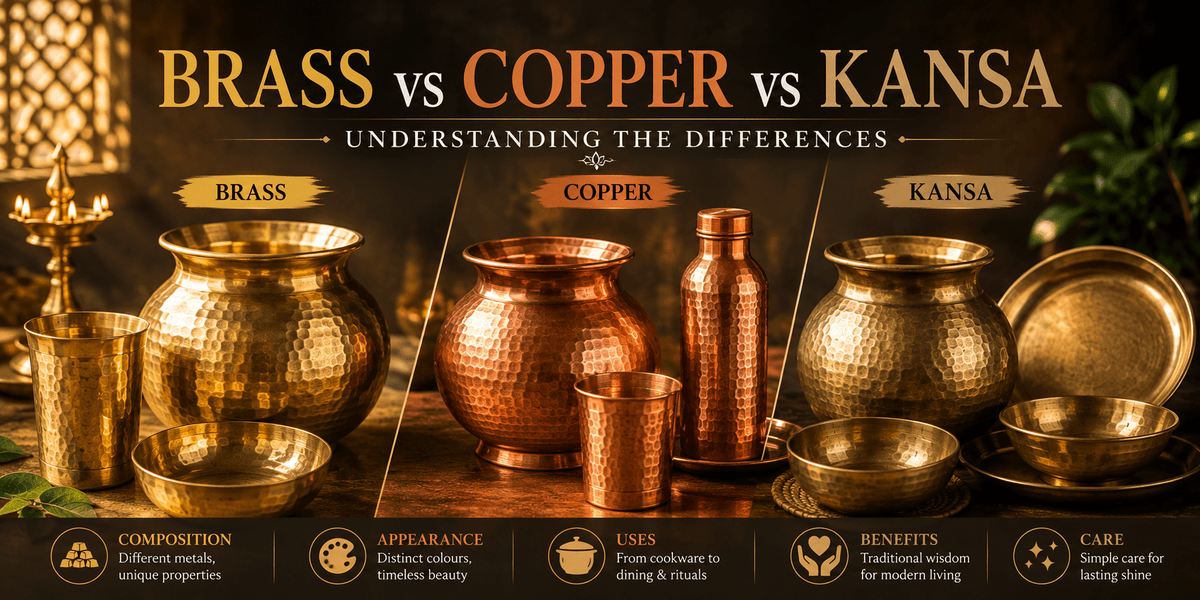
Brass vs Copper vs Kansa: Understanding the Differences
Brass, copper and Kansa each have unique properties, colours and traditional uses. Compare their differences and discover which metal is best for dining, pooja, décor and everyday use.
Read more