

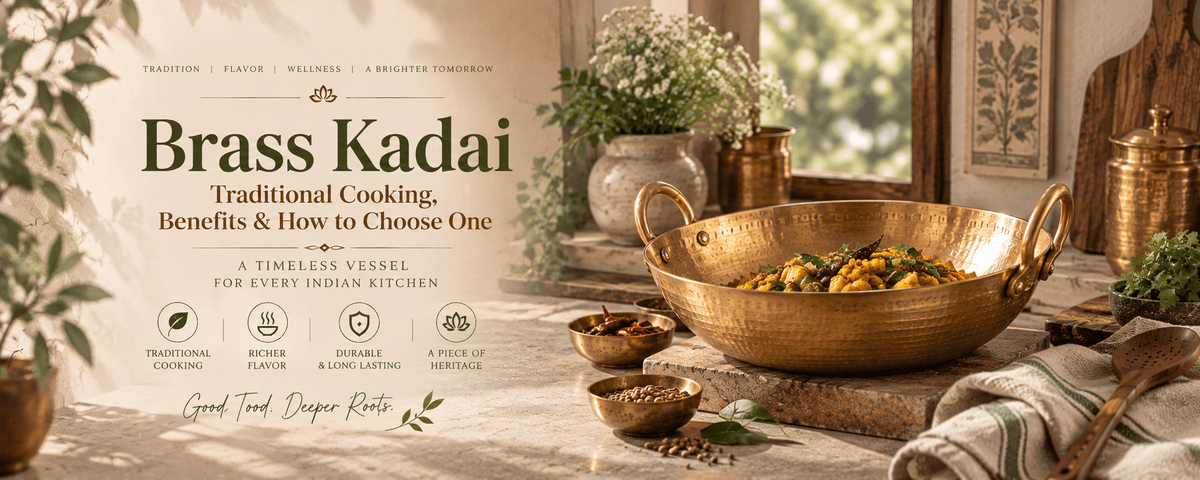
Brass Kadai: Traditional Cooking, Benefits & How to Choose One
A brass kadai is more than a traditional cooking vessel. For generations, the wide, rounded pan has been part of Indian kitchens where cooking was closely connected with craftsmanship, family traditions and carefully chosen utensils .
Today, it remains one of the most recognizable pieces of brass cookware for traditional and heritage-inspired kitchens.
With its broad cooking surface, curved sides and sturdy handles, a brass kadai can bring a distinctly traditional character to the kitchen. Today, handcrafted brass kadais are also finding a place in heritage-inspired and contemporary kitchens, particularly among people who appreciate traditional Indian cookware.
But choosing one requires more than simply looking at its appearance. The metal composition, thickness, construction, finish, lining and intended use all matter.
In this guide, we will explore what a brass kadai is, how it has traditionally been used, what makes it different, what to consider before buying one and how to care for it properly.
Table of Contents
-
What Is a Brass Kadai?
-
Why Was the Kadai Important in Indian Kitchens?
-
Traditional Uses of a Brass Kadai
-
Benefits of a Brass Kadai
-
How Brass Kadai Construction Affects Performance
-
What to Check Before Buying a Brass Kadai
-
Lined vs Unlined Brass Kadai
-
How to Care for a Brass Kadai
-
Brass Kadai vs Other Traditional Cooking Vessels
-
Is a Brass Kadai Right for Your Kitchen?
-
Frequently Asked Questions
-
Final Thoughts
What Is a Brass Kadai?

(Handcrafted brass kadai in a traditional Indian kitchen)
A brass kadai is a traditional Indian cooking pan made from brass, an alloy primarily composed of copper and zinc. It generally has a wide, deep body with gently sloping or curved sides and two side handles.
Traditional brass kadais may feature hand-hammered surfaces, visible artisan marks and naturally varied finishes. These details give each handcrafted vessel its own character.
The shape is particularly practical for Indian cooking. Its depth helps contain ingredients while the broad opening makes it convenient for stirring, frying and preparing dishes in larger quantities.
If you are unfamiliar with brass as a material, our guide What Is Brass? explains its composition, characteristics, uses and place in Indian heritage.
Why Was the Kadai Important in Indian Kitchens?
The kadai has long been associated with everyday Indian cooking because its shape works well with many different preparation techniques.
Unlike a flat pan, a kadai has depth. This makes it useful when ingredients need to be stirred, tossed or cooked with sauces and gravies.
Traditional kitchens commonly relied on different vessels for different tasks. A kadai could be used for preparations that required a deeper cooking surface, while other vessels were chosen for boiling, slow cooking, serving or food preparation.
The brass kadai therefore represents more than a particular piece of cookware—it reflects the traditional Indian approach of choosing a vessel according to the cooking method.
The brass kadai is just one of several traditional cooking vessels. Learn more about the different forms and uses in our guide to Brass Cookware Types Explained.
Traditional Uses of a Brass Kadai

(Traditional brass kadai used for Indian cooking)
The versatility of a kadai is one of its most recognizable features. If you are looking for a handcrafted option, explore our brass kadai collection to compare available designs and sizes.
1. Stir-Frying
The wide cooking surface makes a kadai suitable for stir-frying vegetables, paneer and other ingredients.
The curved sides also make it easier to move food around while cooking.
2. Preparing Curries and Gravies
A deeper kadai provides room for curries, gravies and vegetable preparations.
However, because brass can react with certain acidic foods, always follow the manufacturer's instructions regarding whether the vessel is lined and which foods are suitable for cooking in it.
3. Shallow Frying
Traditional kadais are associated with frying because their depth helps contain oil and ingredients more effectively than a flat pan.
For brass cookware, the manufacturer's recommended heat level and usage instructions should always be followed.
4. Preparing Traditional Indian Dishes
A handcrafted brass kadai can be used for selected traditional preparations where its construction and lining are appropriate.
Its visual character also makes it particularly attractive when food moves directly from the kitchen to the table in traditional serving settings.
5. Cooking Larger Portions
The broad body of a kadai makes larger models useful when preparing food for families or gatherings.
The right size depends on household requirements, cooking habits and available storage space.
Benefits of a Brass Kadai
The appeal of a brass kadai comes from a combination of function, craftsmanship and heritage.
1. Traditional Indian Craftsmanship
Handcrafted brass cookware often carries visible evidence of the artisan's work. Hammered surfaces, shaped handles and small variations can make each piece feel individual.
This craftsmanship is an important part of India's long metalworking tradition.
Brass is only one of the traditional metals used in Indian kitchenware. Our guide to Brass vs Copper vs Kansa explains the key differences between these three materials.
2. Distinctive Heat Behaviour
Brass is a metal alloy containing copper, and brass cookware can have different thermal characteristics depending on its composition, thickness and construction.
For this reason, the actual cooking performance of one brass kadai can differ from another. Rather than judging performance from appearance alone, look at the vessel's construction and follow the manufacturer's cooking recommendations.
3. Durable Construction
A well-made brass kadai can become a long-lasting kitchen piece when handled and maintained properly.
Thickness, joint quality, handle construction and finish all contribute to durability.
4. Timeless Appearance
The warm tone of brass naturally adds character to a kitchen.
A handcrafted kadai can work equally well in a traditional kitchen, a rustic setting or a contemporary kitchen that incorporates Indian heritage pieces.
5. Heritage Value
For many households, traditional cookware carries memories of family kitchens and generations of cooking practices.
A brass kadai can therefore serve both a practical purpose and a connection to Indian culinary heritage.
How Brass Kadai Construction Affects Performance

(Close-up of hammered texture on a handcrafted brass kadai)
Not every brass kadai is made in exactly the same way.
When comparing different vessels, pay attention to several construction details.
Thickness
A heavier, well-constructed kadai may feel more substantial and durable than a very thin vessel.
However, heavier does not automatically mean better. Consider the intended cooking use, handling comfort and the manufacturer's specifications.
Hammered or Smooth Finish
A hammered finish creates a distinctive textured appearance and is often associated with handcrafted brassware.
A smooth finish provides a more understated look.
Neither finish alone determines whether a kadai is suitable for cooking. Construction quality and intended use are more important.
Handles
Check whether the handles are firmly attached and comfortable to hold.
A kadai becomes considerably easier to handle when the side handles are sturdy and properly proportioned to the vessel.
Interior Lining
This is one of the most important things to check before buying.
Some brass cooking vessels are lined with another metal on the cooking surface. Others may be intended for specific uses only.
Always check whether the brass kadai is lined, what the lining material is, and what foods and cooking methods the manufacturer recommends.
What to Check Before Buying a Brass Kadai
If you are planning to purchase a brass kadai, use this simple checklist. For a broader comparison of traditional kitchen vessels, you can also read our Best Brass Utensils for Indian Cooking: A Complete Buying Guide.
1. Check the Material
Look for clear information about the brass used in the vessel.
Avoid choosing solely on the basis of colour or shine because appearance does not establish metal composition.
2. Check the Size
Think about how many people you usually cook for.
A smaller kadai may be easier to handle for everyday meals, while a larger one may be more practical for family cooking and gatherings.
3. Check the Construction
Look closely at:
-
Body thickness
-
Handle attachment
-
Rim finishing
-
Interior surface
-
Overall weight
-
Surface consistency
4. Ask About the Lining
If the product has an interior lining, check what material has been used and how it should be maintained.
Also check whether the lining is suitable for your intended cooking methods.
5. Check Heat and Stove Compatibility
Do not assume that every traditional brass kadai is compatible with every type of cooktop.
Check the manufacturer's instructions before using it on gas, induction or other cooking surfaces.
6. Look for Craftsmanship
If you prefer handcrafted cookware, examine the hammering, shaping and finishing.
Small variations can be part of handmade craftsmanship rather than defects.
7. Consider Maintenance
Brass naturally changes appearance over time. Some people prefer a bright polished finish, while others appreciate the deeper character of naturally aged brass.
Choose a kadai whose maintenance requirements fit your routine.
Lined vs Unlined Brass Kadai
One of the biggest purchasing considerations is whether the cooking surface is lined.
Lined Brass Kadai
A lining creates a barrier between the food and the brass surface.
The exact lining material and care requirements vary by product, so buyers should check the manufacturer's specifications carefully.
Unlined Brass Kadai
An unlined brass vessel has a direct brass cooking surface.
Because brass can interact with certain foods, particularly acidic ingredients, it is important not to assume that every unlined brass kadai is suitable for every recipe.
The safest approach is to follow the specific manufacturer's instructions for your vessel.
How to Care for a Brass Kadai
Good maintenance can help preserve both the appearance and functionality of brass. For more detailed maintenance advice, see our guide on how to clean and care for brass utensils. cookware.
Wash Gently
Use a soft sponge or cloth with mild cleaning soap where appropriate.
Avoid aggressive abrasive scrubbers that can scratch the surface.
Dry Immediately
After washing, dry the kadai thoroughly with a soft cloth.
Leaving moisture on brass for extended periods can affect its appearance.
Avoid Harsh Chemicals
Strong cleaning chemicals can damage the finish and may be unsuitable for lined cookware.
Always use the care method recommended for your specific product.
Maintain the Lining Carefully
If your kadai has an interior lining, take special care not to scratch or wear it down.
Avoid metal scrubbers unless specifically recommended by the manufacturer.
Accept Natural Patina
Brass naturally develops changes in colour and surface character with use.
For many traditional cookware enthusiasts, this gradual patina is part of the charm of brass rather than something that needs to be eliminated completely.
Brass Kadai vs Other Traditional Cooking Vessels

(Brass kadai with traditional Indian brass cooking vessels)
A kadai is only one part of India's traditional cookware heritage.
A degchi is generally deeper and commonly associated with preparations such as rice, gravies and one-pot dishes.
A handi has a distinctive rounded body and is traditionally associated with slow cooking and rich preparations.
A tawa has a broad, flat surface and is better suited to flatbreads and griddle cooking.
A patila is typically taller and useful for boiling and everyday cooking.
A parat, on the other hand, is a wide, shallow vessel traditionally associated with mixing and kneading rather than cooking.
Understanding these differences makes it easier to choose cookware according to the task rather than simply buying the most attractive vessel.
For a broader look at traditional Indian kitchen vessels, read our guide to Traditional Indian Metal Utensils.
Is a Brass Kadai Right for Your Kitchen?
A brass kadai can be an excellent choice if you appreciate traditional Indian cookware, handcrafted metalwork and heritage-inspired kitchenware.
It is particularly appealing to people who want cookware that feels connected to Indian culinary traditions rather than purely modern, mass-produced kitchen equipment.
However, it is important to choose based on construction, lining, size, intended use and care requirements, not appearance alone.
If you are building a traditional cookware collection, a kadai can also be paired with other vessels such as a degchi, handi, tawa and parat to create a more versatile kitchen setup.
Frequently Asked Questions
Is a brass kadai good for cooking?
A brass kadai can be suitable for cooking when it is specifically designed and finished for cooking use. Always follow the manufacturer's instructions regarding heat, lining and suitable foods.
What can you cook in a brass kadai?
Depending on its construction and lining, a brass kadai may be used for selected Indian cooking techniques such as stir-frying, shallow frying and preparing certain curries or vegetable dishes. Always check the product's recommended uses.
Is a brass kadai safe for acidic foods?
Brass can react with acidic ingredients. Whether a particular kadai can be used for acidic foods depends on its construction and interior lining. Follow the manufacturer's instructions rather than assuming that all brass cookware is suitable.
How do I clean a brass kadai?
Use the cleaning method recommended for your particular vessel. Generally, gentle washing with a soft cloth or sponge is preferable to harsh abrasive scrubbing. Lined cookware requires additional care to protect the interior.
Does brass cookware change colour?
Yes. Brass can naturally develop variations in colour and patina over time. Exposure to air, moisture, heat and regular handling can influence its appearance.
Is a hammered brass kadai better than a smooth one?
A hammered finish is primarily a matter of craftsmanship and appearance. The quality of a kadai depends on factors such as material, construction, thickness, handles and intended use rather than texture alone.
How do I choose the right size brass kadai?
Choose the size according to your typical cooking quantity, number of people in your household and storage space. A smaller kadai is convenient for everyday portions, while a larger one can be useful for family meals and gatherings.
Can a brass kadai be used on an induction stove?
Do not assume that it can. Brass itself is not generally induction-compatible, and compatibility depends on the specific construction of the cookware. Always check the manufacturer's specifications.
How long can a brass kadai last?
A well-made brass kadai can be a durable kitchen vessel when it is used correctly and maintained according to the manufacturer's care instructions.
Why are handcrafted brass kadais different?
Handcrafted kadais can have individual hammer marks, shaping variations and finishing details that reflect the artisan's work. These characteristics give traditional brassware a distinctive appearance.
Final Thoughts
A brass kadai brings together three elements that have remained important in Indian kitchens for generations: function, craftsmanship and tradition.
Its broad shape makes it versatile for selected cooking techniques, while its warm metal finish and handcrafted character give it a presence that modern cookware often lacks.
But buying the right brass kadai is about more than choosing the brightest or heaviest vessel. Consider its construction, thickness, lining, size, handle quality, cooking compatibility and maintenance requirements.
When chosen carefully and cared for properly, a brass kadai can become more than another kitchen utensil—it can become a lasting part of your kitchen's culinary heritage.
For more traditional cookware and practical product guides, explore the Product Intelligence Hub at Royal Stuffs.
Read more
Best Brass Utensils for Indian Cooking: A Complete Buying Guide
Discover the best brass utensils for Indian cooking, from kadai and degchi to tawa, patila and parat. Learn how to choose the right brass cookware based on design, quality, cooking needs and tradit...
Read more
Copper Kadai for Cooking: Benefits, Uses & Buying Guide
Discover the traditional appeal of copper kadai for Indian cooking. Learn about its uses, benefits, key features, care requirements and what to consider before choosing one for your kitchen.
Read more