

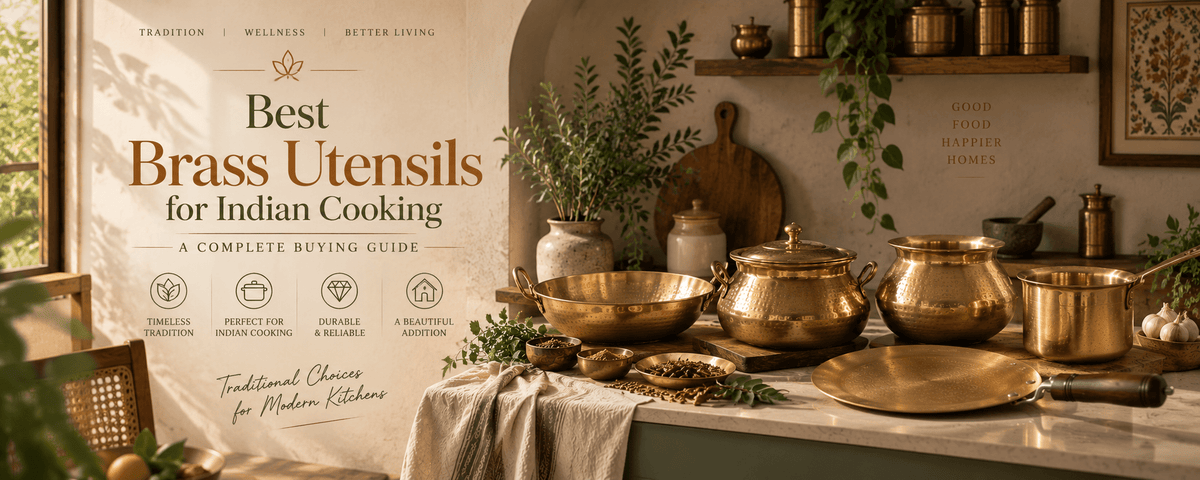
Best Brass Utensils for Indian Cooking: A Complete Buying Guide
Brass has been part of Indian kitchens for generations. From cooking vessels and storage containers to serving utensils, its warm golden appearance and handcrafted character have made it much more than an ordinary kitchen material.
Today, brass utensils are finding their way back into modern Indian homes. But choosing the right vessel can be confusing. Should you buy a brass kadai for everyday cooking? Is a degchi better for rice and gravies? What is a parat used for? And what should you check before buying pure brass utensils?
This guide explains the most useful brass utensils for Indian cooking, their traditional purposes, what to look for when buying them, and how to choose pieces that genuinely suit your kitchen.
Table of Contents
-
Why Choose Brass Utensils for Indian Cooking?
-
Best Brass Utensils for an Indian Kitchen
-
Brass Kadai
-
Brass Degchi
-
Brass Handi
-
Brass Tawa
-
Brass Patila and Cooking Pots
-
Brass Parat
-
Brass Containers and Storage Utensils
-
How to Choose the Best Brass Utensils
-
Pure Brass vs Brass-Alloy Products
-
Should Brass Utensils Be Used Every Day?
-
How to Care for Brass Kitchen Utensils
-
Brass Utensils for Traditional and Modern Kitchens
-
Frequently Asked Questions
-
Conclusion
Why Choose Brass Utensils for Indian Cooking?
Traditional Indian kitchens were built around practical vessels suited to different cooking and serving tasks. Brass became an important part of this kitchen heritage because it could be shaped into a wide range of useful forms.
Its golden-yellow appearance also gave ordinary kitchen vessels a distinctive character.
However, buying brass cookware should not be based on appearance alone.
The right vessel depends on:
-
The type of food you prepare
-
Cooking method
-
Vessel size
-
Thickness and construction
-
Whether the vessel has an interior lining
-
Manufacturer's instructions
-
How frequently you intend to use it
-
Ease of cleaning and maintenance
For shoppers exploring traditional kitchenware, the brass kitchen utensils collection offers a useful starting point for comparing different forms and sizes.
If you are completely new to brass as a material, you can also read our guide to What Is Brass? A Complete Beginner's Guide to Brass Metal, Uses & Indian Heritage.
Best Brass Utensils for an Indian Kitchen
There is no single "best" brass utensil for every kitchen. Different vessels are designed around different cooking and preparation needs.
| Brass Utensil | Traditional Use | Best For |
|---|---|---|
| Brass Kadai | Frying and cooking | Sabzi, frying, shallow cooking |
| Brass Degchi | Covered cooking | Rice, dal, gravies |
| Brass Handi | Slow and traditional cooking | Curries, rice-based dishes |
| Brass Tawa | Flat-surface cooking | Rotis and flatbreads, where suitable |
| Brass Patila | General cooking | Boiling, simmering and preparation |
| Brass Parat | Food preparation | Dough mixing and kneading |
| Brass Container | Storage | Dry ingredients and kitchen organization |
Understanding these differences makes it much easier to build a practical brass kitchen rather than buying vessels simply because they look beautiful.
Brass Kadai

(Handcrafted brass kadai for traditional Indian cooking)
A brass kadai is one of the most recognizable traditional Indian cooking vessels.
Its broad shape and curved sides make it useful for cooking preparations that require stirring, frying or tossing. Depending on its construction and manufacturer's instructions, it can be used for particular traditional cooking applications.
A kadai can be particularly useful for:
-
Vegetable preparations
-
Frying
-
Shallow cooking
-
Gravies
-
Traditional Indian recipes
When choosing a brass kadai, pay attention to the diameter, depth, thickness and handle construction.
A smaller kadai can work well for compact household cooking, while a larger one may be more suitable for family meals.
The shape also matters. A deeper kadai provides more room for stirring, while a wider cooking surface can be convenient for certain preparations.
Brass Degchi

(Traditional brass degchi and handi cooking vessels)
The degchi is a traditional deep cooking vessel with a rounded or gently curved body. It is commonly associated with preparations such as rice, dal and gravies.
A covered brass degchi can also create the visual feel of a traditional Indian kitchen while remaining practical as a specialized cookware piece.
When buying one, look at:
-
Capacity
-
Lid fit
-
Vessel depth
-
Wall thickness
-
Handle design
-
Interior finish or lining
For vessels intended for direct cooking, always follow the manufacturer's instructions about suitable foods, heat levels and usage.
The degchi is especially attractive for people who want to recreate the look and feel of traditional Indian cooking without filling the kitchen with dozens of specialized pieces.
Brass Handi
The rounded profile of a brass handi gives it a distinctive place in Indian cookware traditions.
Its shape makes it suitable for slow, covered and traditional-style preparations, depending on the construction of the particular vessel.
A handi can be useful for:
-
Rice preparations
-
Curries
-
Dal
-
Slow cooking
-
Traditional serving
One of the most important things to check is whether the specific brass handi is intended for cooking, serving, or both.
Not every decorative-looking brass vessel is automatically suitable for direct heat.
Brass Tawa

(Traditional handcrafted brass tawa for Indian flatbreads)
A tawa has a completely different shape from a kadai or handi.
Its broad, flat surface is designed for foods that need direct contact with a cooking surface.
Traditional Indian kitchens commonly use tawas for preparations such as:
-
Rotis
-
Parathas
-
Flatbreads
-
Pancake-style preparations
When buying a brass tawa, consider the cooking surface diameter and handle design.
A heavier tawa may feel more substantial, but it can also require more storage space and handling.
If you regularly make flatbreads, choose a size that comfortably fits your stovetop and matches your preferred cooking style.
Brass Patila and Cooking Pots

(Handcrafted brass patila traditional Indian cooking pot)
The humble patila is one of the most practical shapes in Indian kitchenware.
A traditional brass patila can be used for different kitchen tasks depending on its size, construction and intended use.
It can be useful for:
-
Boiling
-
Simmering
-
Preparing larger quantities
-
General kitchen preparation
For a family kitchen, a combination of smaller and medium-sized vessels can often be more practical than purchasing one very large pot.
Look for sturdy handles, a stable base and a well-finished rim.
Brass Parat

(Wide handcrafted brass parat for dough preparation)
Unlike the other vessels in this guide, a brass parat is primarily associated with food preparation rather than stovetop cooking.
A brass parat is a wide, shallow traditional vessel commonly used for tasks such as:
-
Kneading dough
-
Mixing ingredients
-
Preparing flour-based foods
-
Holding ingredients during preparation
Its broad surface gives you plenty of working space.
This is also one of the brass kitchen products where size becomes particularly important. A larger parat can be convenient for family-sized dough preparation, while a smaller one may be easier to store.
Brass parat is also a strong traditional-kitchen choice for anyone who appreciates handcrafted Indian metalware.
Brass Containers and Storage Utensils
Brass containers can add both function and visual character to an Indian kitchen.
They may be used for storing suitable dry ingredients, spices or other kitchen items, depending on the product design and manufacturer's recommendations.
When shopping for a brass container, consider:
-
Capacity
-
Lid design
-
Opening size
-
Interior finish
-
Ease of cleaning
-
Intended food-contact use
A container with a secure lid is particularly useful when the contents need protection from moisture and dust.
How to Choose the Best Brass Utensils

(Different brass utensils for Indian cooking and food preparation)
Buying traditional metalware becomes much easier when you evaluate the vessel beyond its appearance.
1. Start With Your Cooking Habits
Think about what you actually cook.
If you frequently prepare sabzi or fried foods, a kadai may be more useful than a large handi.
If rice and slow-cooked dishes are regular parts of your meals, a degchi or suitable cooking pot may make more sense.
For regular roti-making, consider a tawa.
For dough preparation, choose a parat.
The best brass utensil is ultimately the one that fits your cooking routine.
2. Check the Size
Do not choose a vessel only because it looks impressive.
A very large cooking vessel can be inconvenient for a small household, while a tiny vessel may not be practical for family meals.
Think about:
-
Number of people you cook for
-
Typical portion size
-
Stovetop dimensions
-
Storage space
-
Weight when filled
3. Look at Construction Quality
Inspect the overall construction carefully.
Look for:
-
Even shaping
-
Smooth or well-finished edges
-
Secure handles
-
Stable construction
-
Consistent surface finishing
-
Properly fitted lids where applicable
Handcrafted brass may naturally show subtle variations. These marks can be part of the character of traditionally made metalware rather than automatically being defects.
4. Ask About the Interior
This is particularly important for cookware.
Some brass cooking vessels may have an interior lining or coating designed for specific food-contact and cooking requirements.
Do not assume that every brass vessel has the same interior construction.
Before buying, check the product specifications and manufacturer's instructions regarding:
-
Cooking suitability
-
Food compatibility
-
Heat use
-
Cleaning
-
Re-tinning or maintenance, if applicable
5. Consider Thickness and Weight
Thickness can affect how a vessel feels, handles heat and performs in the kitchen.
However, heavier does not automatically mean better.
The ideal construction depends on the type of vessel and how it is intended to be used.
Pure Brass vs Brass-Alloy Products

(Natural brass surface and handcrafted kitchen utensil textures)
One of the most important questions buyers ask is whether a product is pure brass.
Brass itself is an alloy primarily made from copper and zinc. Therefore, the phrase "pure brass" generally refers to a specified brass composition rather than a chemically pure elemental metal.
This is why buyers should look for clear product information instead of relying only on colour or appearance.
When comparing brass utensils, check:
-
Material description
-
Product specifications
-
Manufacturing details
-
Interior lining
-
Intended use
-
Seller information
A bright yellow surface alone cannot tell you the exact composition of a brass product.
For a broader understanding of traditional Indian metals, our guide Brass vs Copper vs Kansa: Understanding the Differences explains how these materials differ in composition, appearance and traditional applications.
Should Brass Utensils Be Used Every Day?
Brass utensils can certainly be part of a modern kitchen, but whether a particular piece is suitable for everyday cooking depends on its construction and intended use.
This distinction is important.
A brass serving bowl, decorative vessel and purpose-built cooking utensil should not automatically be treated in exactly the same way.
For cookware:
Always follow the manufacturer's instructions.
Pay attention to whether the vessel is:
-
Designed for direct cooking
-
Intended only for serving
-
Lined on the inside
-
Suitable for particular foods
-
Suitable for your cooking method
This approach allows you to enjoy traditional brassware while using it responsibly.
How to Care for Brass Kitchen Utensils
Brass develops a natural patina over time. Some people prefer the bright polished appearance, while others enjoy the deeper aged character that develops with use.
Basic care includes:
-
Wash according to the manufacturer's instructions.
-
Avoid harsh abrasive scrubbing unless specifically recommended.
-
Dry the utensil thoroughly after washing.
-
Store it in a dry environment.
-
Follow specific instructions for lined cookware.
-
Do not assume every household cleaning method is suitable for every brass finish.
For a vessel intended for food contact, use cleaning methods appropriate for that product.
If you want to learn more about traditional Indian metalware and how different vessels fit into the kitchen, our guide to Traditional Indian Metal Utensils: A Journey Through India's Kitchen Heritage is a useful next read.
Brass Utensils for Traditional and Modern Kitchens
Brass does not have to make a kitchen look old-fashioned.
The beauty of traditional metalware is that it can work with modern interiors just as naturally as it works in heritage kitchens.
Pair brass vessels with:
-
Natural wood
-
Stone countertops
-
Cotton textiles
-
Ceramic storage jars
-
Wooden kitchen tools
-
Neutral cabinetry
-
Green plants
A brass kadai can sit beside contemporary cookware. A brass parat can become part of a modern baking setup. Brass containers can bring warmth to open kitchen shelving.
The result is not necessarily a completely traditional kitchen.
It is a balance between Indian heritage and modern living.
Frequently Asked Questions
Which brass utensil is best for Indian cooking?
There is no single best option. A brass kadai, degchi, handi, tawa or patila serves a different purpose. Choose according to the foods you prepare and the manufacturer's intended use of the vessel.
Are brass utensils suitable for everyday cooking?
Some brass utensils are designed for cooking, while others are intended for serving or decoration. Always check the product specifications, interior construction and manufacturer's instructions before using a brass vessel for everyday cooking.
What is the most useful brass utensil for a traditional kitchen?
A kadai, cooking pot or degchi can be highly useful for cooking, while a parat is particularly practical for dough preparation and food mixing.
What is a brass parat used for?
A brass parat is traditionally used for food preparation tasks such as kneading dough and mixing ingredients.
How do I choose the right brass kadai size?
Consider the number of people you cook for, typical portion sizes, stovetop dimensions and storage space. A smaller kadai may suit everyday meals for a small household, while a larger one can be useful for family cooking.
Does heavier brass cookware mean better quality?
Not necessarily. Weight should be considered alongside construction, thickness, workmanship, intended use and overall product specifications.
How can I identify good-quality brass utensils?
Look at the material information, construction, finish, handle quality, thickness, product specifications and intended use. Do not judge quality by colour alone.
Does brass change colour over time?
Yes. Brass can develop a darker or more aged appearance as its surface changes with exposure and use. This natural patina is part of the character of brass.
Can brass cookware have an interior lining?
Yes. Some brass cookware is made with an interior lining or coating. The lining and its maintenance requirements depend on the specific product, so always follow the manufacturer's care instructions.
Are brass utensils good for gifting?
Yes. Handcrafted brass utensils can make meaningful gifts because they combine practical kitchen use with traditional Indian craftsmanship. Smaller vessels, serving pieces and traditional kitchen accessories can be especially suitable for gifting.
Conclusion
The best brass utensils are not necessarily the biggest, heaviest or most decorative ones.
They are the vessels that match how you cook, what you prepare and how you want to use traditional metalware in your home.
A brass kadai can become a versatile cooking companion. A degchi can bring the character of traditional cooking to rice and gravies. A tawa can serve flatbread preparations, while a parat can become part of everyday food preparation. Brass containers can add warmth and organization to the kitchen.
Most importantly, buy with purpose.
Check the material, construction, size, interior finish and intended use before making a decision. When cared for properly, well-made brass kitchenware can become more than a cookware purchase—it can become a lasting connection to India's rich culinary and metalworking heritage.
Explore the Royal Stuffs brass kitchen utensils collection to discover handcrafted traditional pieces for your kitchen.
Read more
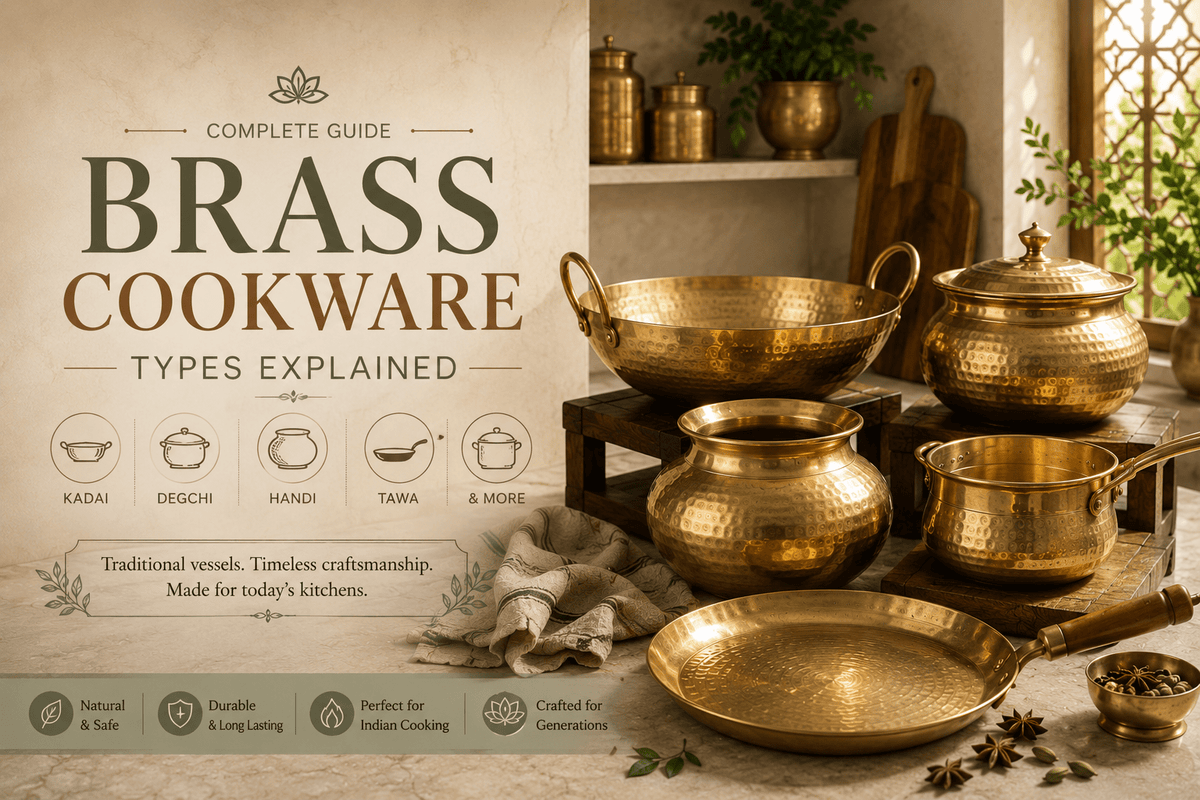
Brass Cookware Types Explained: Kadai, Degchi, Handi, Tawa & Traditional Cooking Vessels
Discover the different types of traditional brass cookware, from kadai and degchi to handi, tawa, patila and parat. Learn how each vessel is used and find the right brass cookware for your kitchen.
Read more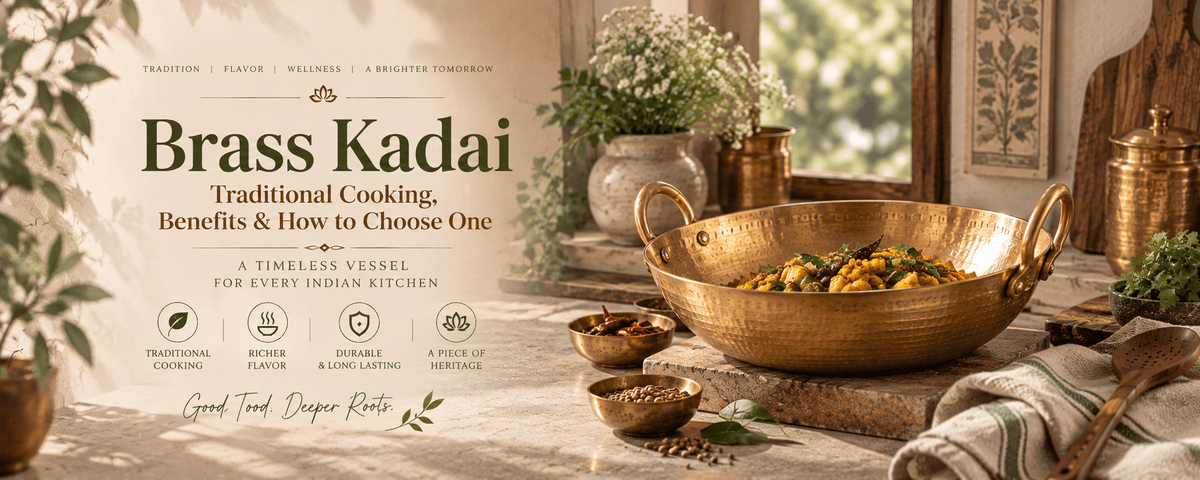
Brass Kadai: Traditional Cooking, Benefits & How to Choose One
Discover the traditional uses, benefits and key features of a brass kadai. Learn how to choose the right brass kadai for Indian cooking and care for it properly.
Read more