


Temple History, Architecture & Sacred Scriptures: Understanding India’s Living Heritage
Introduction
Across India, temples are far more than places of worship. They are living expressions of history, architecture, philosophy, art and devotion. From the towering gopurams of South India to the intricately carved temples of Odisha and the stone sanctuaries of North India, each temple reflects the culture and spiritual traditions of the region in which it was built.
For thousands of years, Indian temples have served as places where people come to pray, celebrate festivals, seek blessings and connect with something greater than themselves. Their architecture is equally meaningful. Temple entrances, pillars, sanctums, towers, sculptures and courtyards are often designed according to traditional principles that connect the human experience with the cosmic order.
The stories and teachings found in sacred scriptures further deepen this experience. Texts such as the Vedas, Upanishads, Bhagavad Gita, Ramayana, Mahabharata and Puranas have shaped India's religious traditions and influenced the rituals, symbolism and stories associated with temples.
Understanding temple history and architecture therefore allows us to see Indian temples not simply as monuments, but as carefully designed spaces where spirituality, heritage and community come together.
Table of Contents
-
The Origins and History of Indian Temples
-
Why Temples Became Important Centres of Culture
-
Understanding Indian Temple Architecture
-
The Garbhagriha: The Spiritual Heart of a Temple
-
Shikhara, Vimana and Gopuram
-
Mandapas, Pillars and Temple Sculptures
-
Major Styles of Indian Temple Architecture
-
Sacred Scriptures and Temple Traditions
-
How Scriptures Influence Temple Rituals
-
Why Temple Heritage Still Matters Today
-
Exploring India's Temple & Pilgrimage Traditions
-
Conclusion
-
FAQs
1. The Origins and History of Indian Temples

(Ancient Indian temple architecture and heritage craftsmanship)
The history of Indian temples developed gradually alongside India's religious and cultural traditions.
Early Indian religious practices often took place around natural landscapes, sacred trees, rivers, fire altars and other places considered spiritually significant. Over time, permanent structures dedicated to specific deities became increasingly important.
The development of temple architecture became particularly significant during the early medieval period. Different dynasties supported temple construction, and regional architectural traditions began to develop across the Indian subcontinent.
Temples were constructed from materials such as stone, brick and wood, depending on the region. Skilled artisans decorated these structures with carvings depicting deities, mythological stories, animals, floral motifs, celestial beings and scenes from everyday life.
This transformation made the temple a powerful cultural institution.
A temple could simultaneously function as:
-
A place of worship
-
A centre for festivals
-
A gathering place for communities
-
A centre for music and dance
-
A patron of traditional crafts
-
A place associated with learning
-
A symbol of royal and regional heritage
This is one reason India's ancient temples remain important even centuries after their construction.
2. Why Temples Became Important Centres of Culture
Indian temples historically played a role far beyond daily worship.
Large temple complexes could become important centres of local economic and cultural life. Artisans, sculptors, musicians, priests, dancers and other communities were connected with temple traditions.
Temple festivals brought communities together and created opportunities for music, processions, rituals and celebrations.
Many temples also preserved traditional forms of craftsmanship. Stone carving, metalwork, woodwork, textile traditions and decorative arts often developed around religious institutions.
This connection between spirituality and craftsmanship is still visible today in India's handcrafted traditions.
Even objects used in worship—such as brass diyas, pooja thalis, bells, kalash and traditional vessels—carry elements of India's broader cultural heritage.
3. Understanding Indian Temple Architecture

(Traditional Indian temple architecture with carved pillars and shikhara)
One of the most fascinating aspects of Indian temples is that their architecture is deeply symbolic.
Traditional temple design often represents an ordered universe. The temple is conceived as a sacred space that guides a devotee from the outer world toward the spiritual centre.
A typical temple may include several important architectural elements:
-
Garbhagriha – the inner sanctum
-
Mandapa – a pillared hall
-
Shikhara or Vimana – the tower above the sanctum
-
Gopuram – monumental entrance tower, especially prominent in South Indian temples
-
Prakara – enclosing walls
-
Pradakshina patha – circumambulatory passage
-
Temple tank – a sacred water body found in many temple complexes
The arrangement and appearance of these elements vary considerably according to region and architectural tradition.
4. The Garbhagriha: The Spiritual Heart of a Temple

(Sacred Indian temple garbhagriha with brass diya and carved stone entrance)
The garbhagriha, often translated as the "womb chamber," is one of the most important spaces within a traditional Hindu temple.
It is generally the innermost and most sacred part of the temple, where the principal deity is installed.
Unlike the more open areas of a temple, the sanctum is often deliberately enclosed and relatively dark. This creates a strong contrast between the outside environment and the concentrated spiritual atmosphere inside.
The movement toward the garbhagriha can therefore be understood symbolically as a movement from the external world toward an inner spiritual centre.
This is one of the reasons temple architecture is not merely decorative—it is designed to shape the devotee's experience.
5. Shikhara, Vimana and Gopuram

(North and South Indian temple architecture with shikhara and gopuram)
The towering structures associated with Indian temples are among their most recognisable features.
Shikhara
In many North Indian temple traditions, the shikhara rises above the sanctum. It is often tall and curving, creating a strong vertical emphasis.
Vimana
In South Indian temple architecture, the structure directly above the sanctum is generally known as the vimana.
It differs considerably in form from the North Indian shikhara and is often more geometrically tiered.
Gopuram
The gopuram is a monumental gateway, particularly characteristic of large South Indian temple complexes.
These gateways can be covered with elaborate sculptures and colourful depictions of deities and mythological figures.
Together, these architectural forms create the dramatic skyline that makes many Indian temples instantly recognisable.
6. Mandapas, Pillars and Temple Sculptures

(Intricate Indian temple stone sculptures and traditional carvings)
The mandapa is a pillared hall used for gatherings, rituals and other temple activities.
Temple pillars can be extraordinary examples of Indian craftsmanship. Some feature elaborate floral patterns, mythical creatures, dancers, musicians and scenes from sacred stories.
Sculptures on temple walls can also communicate religious ideas through visual storytelling.
For people who could not access written scriptures, temple art historically provided another way of encountering stories and philosophical traditions.
A temple could therefore function almost like a three-dimensional storybook, where mythology and symbolism were expressed through architecture and sculpture.
7. Major Styles of Indian Temple Architecture
India's geographical and cultural diversity has produced several distinctive temple architectural traditions.
Nagara Architecture
Nagara architecture is broadly associated with northern India.
Its characteristic features include:
-
Curving shikhara
-
Sculpted exterior walls
-
Strong vertical forms
-
Detailed stone ornamentation
The temples of Odisha and Khajuraho demonstrate distinctive regional expressions within the broader northern tradition.
Dravidian Architecture
Dravidian architecture is strongly associated with southern India.
It is recognised for:
-
Large temple complexes
-
Monumental gopurams
-
Tiered vimanas
-
Enclosed courtyards
-
Temple tanks
-
Elaborate sculptural decoration
Tamil Nadu is particularly famous for its grand Dravidian temple complexes.
Vesara and Regional Traditions
Central and Deccan India developed architectural forms that combine or reinterpret elements associated with northern and southern traditions.
The important point is that Indian temple architecture is not one uniform style. Each region developed its own visual language influenced by geography, materials, dynasties, local traditions and devotional practices.
8. Sacred Scriptures and Temple Traditions

(Sacred Indian scriptures with traditional brass temple objects and diya)
Temple traditions are deeply connected with India's sacred literature.
The Vedas are among the oldest sacred texts of the Hindu tradition and contain hymns, ritual knowledge and philosophical ideas.
The Upanishads explore profound questions about the self, reality, consciousness and ultimate existence.
The Ramayana and Mahabharata preserve influential narratives that have shaped Indian culture for centuries.
The Bhagavad Gita, which forms part of the Mahabharata, presents a dialogue between Krishna and Arjuna concerning duty, action, knowledge, devotion and spiritual understanding.
The Puranas contain extensive accounts of deities, sacred places, cosmology, legends and religious traditions.
Together, these texts provide an important philosophical and narrative foundation for many traditions associated with Indian temples.
9. How Scriptures Influence Temple Rituals
The connection between scriptures and temples can be seen in many aspects of worship.
Temple traditions may incorporate:
-
Mantras
-
Hymns
-
Offerings
-
Lamps
-
Bells
-
Incense
-
Water rituals
-
Flower offerings
-
Circumambulation
-
Festivals
-
Processions
Many rituals use traditional metal objects such as brass diyas, bells, kalash, plates and vessels.
The lamp, for example, is commonly associated with light, knowledge and the removal of darkness. Similarly, water plays an important role in purification and ritual traditions.
These practices demonstrate how philosophical ideas can become tangible through everyday ritual objects and actions.
Traditional rituals often use objects such as brass diyas, bells, kalash and pooja thalis, each carrying practical and symbolic significance.
10. Why Temple Heritage Still Matters Today
Modern India continues to have a deep relationship with its temple heritage.
People visit temples for many reasons—to pray, celebrate festivals, seek blessings, experience architecture, explore history or reconnect with family traditions.
Pilgrimage also continues to connect different parts of the country.
From the 12 Jyotirlinga temples associated with Shiva to famous Vaishnavite, Shakti and regional pilgrimage centres, India's sacred geography is remarkably diverse.
You can explore our detailed guide to the 12 Jyotirlinga Temples in India to learn about their significance and pilgrimage traditions.
For travellers planning temple visits, our guide to the Best Time to Visit India's Most Famous Temples can also help with seasonal planning.
And if you're looking for inspiration for your next spiritual journey, explore our guide to the Best Pilgrimage Destinations to Visit in India.
11. Temples as Living Heritage
Perhaps the most remarkable thing about Indian temples is that many are not simply archaeological monuments.
They remain living places of worship.
A temple may preserve centuries-old architecture while continuing to host daily prayers, festivals and rituals. This creates a unique relationship between the past and present.
The same cultural continuity can be seen in traditional Indian metalware.
A brass diya used in a contemporary home may follow a design tradition that has existed for generations. A traditional pooja thali may combine practical function with decorative craftsmanship. A brass bell, kalash or serving vessel can similarly connect everyday life with India's artistic heritage.
This is why preserving traditional craftsmanship is an important part of preserving cultural heritage itself.
Traditional brass pooja items continue to connect contemporary homes with India's centuries-old ritual traditions
12. From Temple Architecture to Everyday Indian Heritage
The influence of temple culture extends beyond temple walls.
Indian homes continue to incorporate traditional objects inspired by religious and regional craftsmanship. Brass lamps, diyas, pooja accessories, decorative vessels and traditional dinnerware can bring elements of this heritage into contemporary spaces.
These objects are not simply decorative.
They can represent:
Craftsmanship → Tradition → Ritual → Family → Heritage
This continuity is what makes Indian metalware particularly meaningful as part of modern cultural living.
Bring elements of traditional Indian craftsmanship into the home with a handcrafted brass pooja thali designed for everyday rituals and festive occasions.
Conclusion

(Ancient Indian temple complex at sunset with ornate stone architecture, brass diya, kalash and flower offerings in the foreground.)
India's temples tell stories through stone, metal, architecture, sculpture, ritual and scripture.
Their history reveals the evolution of Indian civilisation. Their architecture demonstrates extraordinary craftsmanship and mathematical planning. Their sculptures preserve stories and symbolism, while sacred scriptures provide philosophical and spiritual foundations for many traditions.
Most importantly, temples remain living spaces where generations continue to participate in rituals, festivals and traditions.
Understanding temple history and architecture therefore means understanding more than buildings. It means discovering a living heritage that continues to influence Indian art, craftsmanship, spirituality and everyday life.
From an ancient stone temple to a handcrafted brass diya glowing in a modern home, the connection between India's past and present continues to shine.
FAQs
What is the importance of temples in Indian culture?
Temples serve as places of worship, pilgrimage, community gathering and cultural expression. Historically, many also supported traditional arts, music, sculpture and craftsmanship.
What are the main styles of Indian temple architecture?
The major architectural traditions commonly discussed are Nagara in northern India and Dravidian in southern India, along with several regional and Deccan traditions.
What is a garbhagriha?
The garbhagriha is the innermost sanctum of a Hindu temple where the principal deity is traditionally installed.
What is the difference between a shikhara and a gopuram?
A shikhara generally refers to the tower over the sanctum in many North Indian temple traditions, while a gopuram is a monumental gateway, particularly prominent in South Indian temple complexes.
Which scriptures are important to Hindu traditions?
Important sacred and philosophical texts include the Vedas, Upanishads, Bhagavad Gita, Ramayana, Mahabharata and Puranas.
Why are temple sculptures important?
Temple sculptures often communicate mythology, religious symbolism, cultural stories and artistic traditions through visual representation.
Read more

12 Jyotirlinga Temples in India: Significance & Pilgrimage Guide
Discover the 12 Jyotirlinga temples in India, their legends, spiritual significance, locations, temple traditions and practical pilgrimage planning tips.
Read more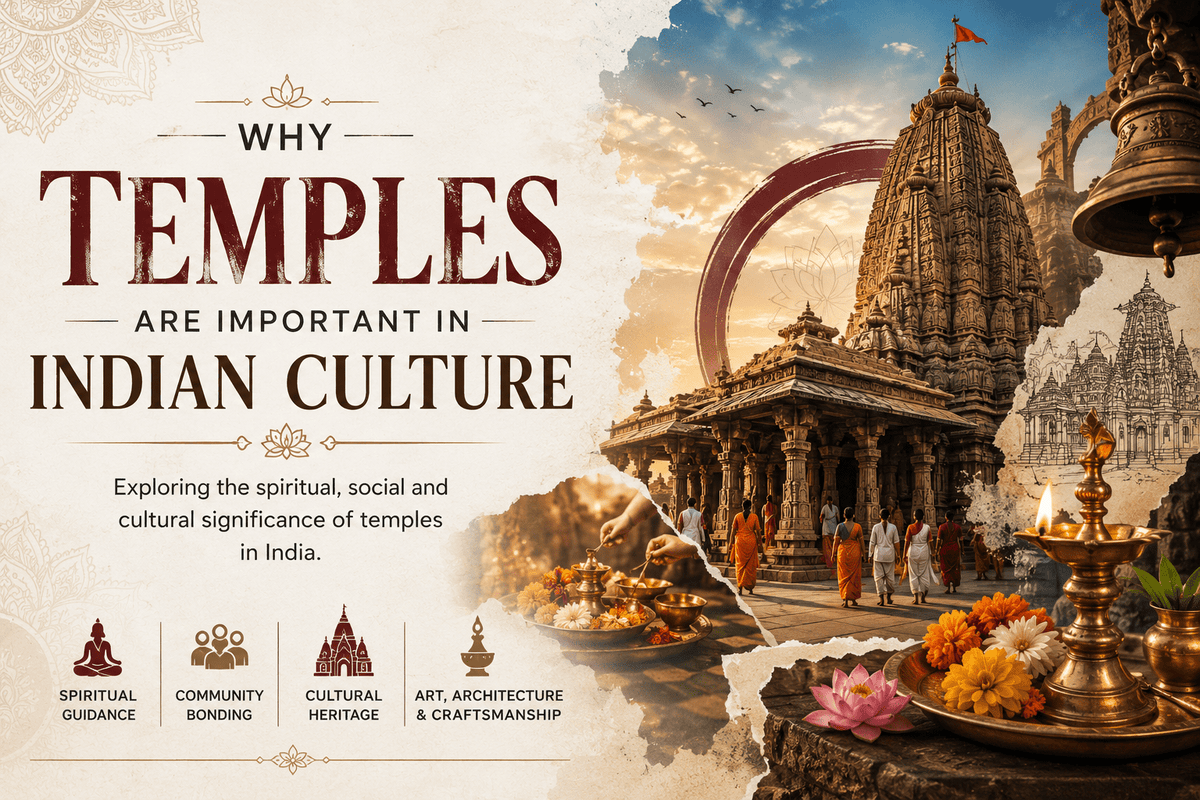
Why Temples Are Important in Indian Culture: Their Spiritual, Social & Cultural Significance
Why are temples important in Indian culture? Discover how Indian temples preserve spirituality, traditions, festivals, craftsmanship, architecture, pilgrimage and community heritage across generati...
Read more