

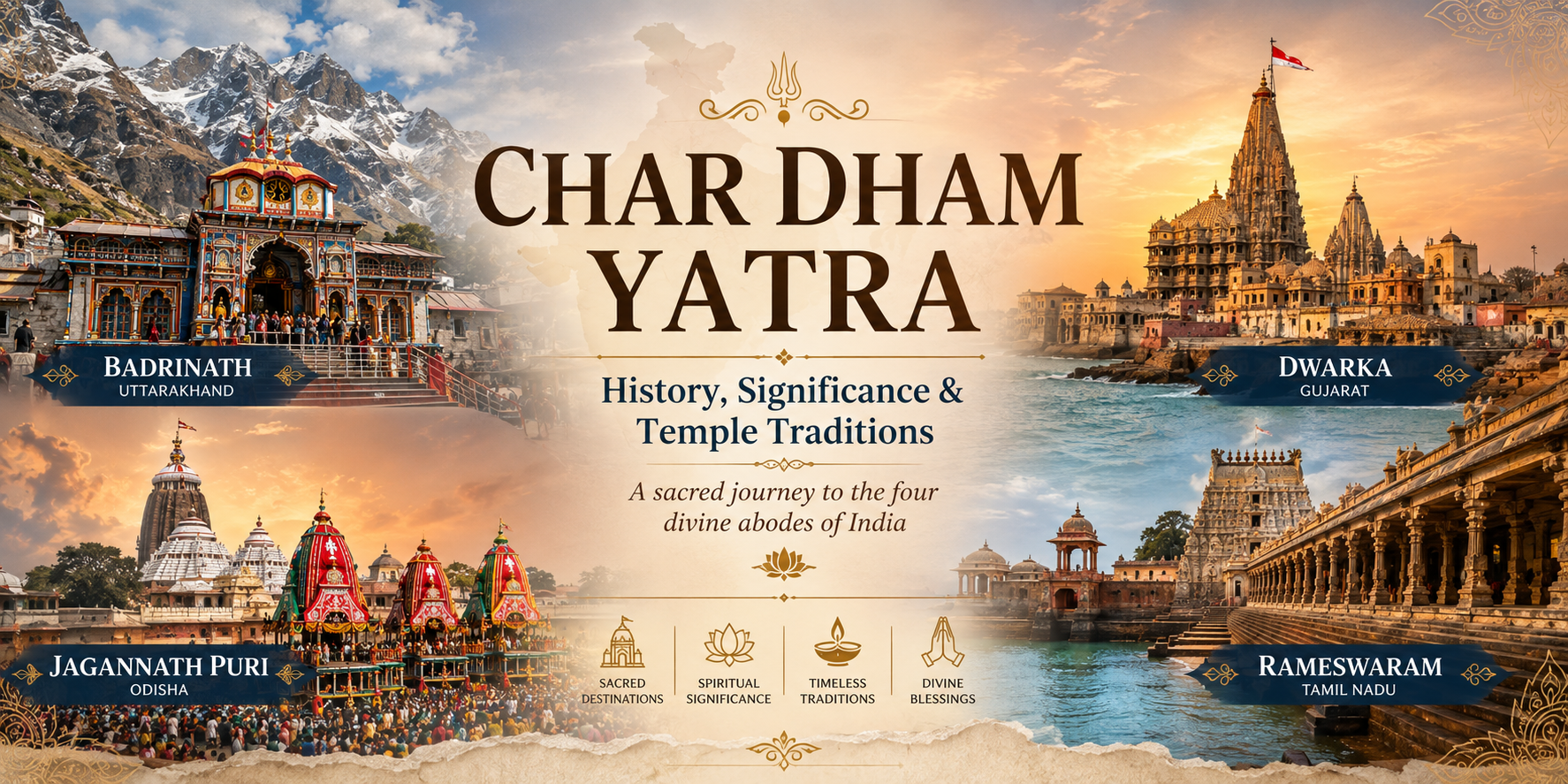
Char Dham Yatra: History, Significance & Temple Traditions
The Char Dham Yatra is one of the most important pilgrimage traditions in Hinduism, connecting four sacred destinations across India: Badrinath in Uttarakhand, Dwarka in Gujarat, Jagannath Puri in Odisha, and Rameswaram in Tamil Nadu.
Each Dham has its own presiding deity, mythology, rituals, festivals, architecture, and regional traditions. Together, these four pilgrimage centres create a spiritual journey that stretches from the Himalayas to the western coast, eastern India, and the southern tip of the country.
If you are new to Hindu pilgrimage, our Beginner’s Guide to Hindu Pilgrimage explains how to plan your first yatra, understand temple etiquette, and prepare for a meaningful spiritual journey.
But what makes the Char Dham Yatra so significant? Who is traditionally associated with the four Dhams? What are the unique traditions of Badrinath, Dwarka, Puri, and Rameswaram? And how is the traditional Char Dham different from the Char Dham circuit of Uttarakhand?
This guide explores the history, significance, temple traditions, major festivals, travel considerations, and spiritual meaning of Char Dham Yatra.
What Is Char Dham Yatra?
The traditional Char Dham refers to four major Hindu pilgrimage destinations located in four different parts of India:
| Char Dham | State | Main Deity / Tradition |
|---|---|---|
| Badrinath | Uttarakhand | Lord Vishnu |
| Dwarka | Gujarat | Lord Krishna |
| Jagannath Puri | Odisha | Lord Jagannath |
| Rameswaram | Tamil Nadu | Lord Shiva |
The four destinations are spread across India's north, west, east, and south, making the Char Dham Yatra both a religious pilgrimage and a journey through India's diverse cultural landscapes.
Badrinath is located in the Garhwal Himalayas, Dwarka on India's western coast, Puri on the eastern coast, and Rameswaram on Pamban Island in Tamil Nadu.
If you are exploring pilgrimage destinations beyond the Char Dham circuit, see our guide to Best Pilgrimage Destinations to Visit in India.
Why Is Char Dham Yatra Important in Hinduism?
The significance of Char Dham Yatra comes from the spiritual importance of each individual pilgrimage centre as well as their connection within a larger pilgrimage tradition.
For devotees, a pilgrimage may represent:
- Seeking blessings and darshan
- Deepening devotion
- Following family traditions
- Fulfilling a spiritual resolve or sankalp
- Visiting sacred places associated with Hindu traditions
- Spending time in prayer and reflection
- Experiencing India's living religious heritage
The journey also brings together different regional forms of Hindu worship.
At Badrinath, pilgrims encounter a major Vaishnava tradition in the Himalayas. At Dwarka, Krishna's sacred city forms the centre of the pilgrimage. Puri is shaped by the unique Jagannath tradition, while Rameswaram brings together the worship of Shiva with traditions connected to the Ramayana.
This diversity is one of the most fascinating aspects of the Char Dham pilgrimage.
History of Char Dham Yatra
The traditional Char Dham circuit is closely associated with Adi Shankaracharya, the influential Hindu philosopher traditionally associated with the development of major monastic centres and pilgrimage traditions.
Odisha Tourism specifically identifies Puri as one of the four Char Dham sites and associates the Char Dham tradition with Adi Shankaracharya.
However, it is important to understand that the four temples themselves have different histories and much older religious traditions.
Their stories developed over centuries through mythology, temple worship, royal patronage, architectural changes, festivals, and local customs.
Therefore, the history of Char Dham is best understood as a combination of:
ancient sacred traditions + temple histories + pilgrimage culture + living rituals.
The Four Char Dham Temples
1. Badrinath Dham – Sacred Abode of Lord Vishnu

(Badrinath Temple surrounded by the Himalayan mountains in Uttarakhand)
Located in the Garhwal Himalayas of Uttarakhand, Badrinath Temple, also known as Badrinarayan Temple, is dedicated to Lord Vishnu.
The temple stands at an elevation of around 3,100 metres beside the Alaknanda River. Uttarakhand Tourism identifies Badrinath as one of the four Dhams and notes its traditional association with Adi Shankaracharya.
Religious Significance of Badrinath
Badrinath is particularly important within Vaishnava traditions. The sacred town is surrounded by the Himalayan landscape, giving the pilgrimage a distinctive spiritual atmosphere.
Traditional stories associate the location with Lord Vishnu's meditation.
The temple's remote Himalayan setting also shapes the pilgrimage experience. The severe winter conditions mean that the temple's annual opening and closing are seasonal. Uttarakhand Tourism notes that the temple generally remains open for around six months each year.
Badrinath Temple Traditions
The temple complex includes traditional worship spaces where devotees come for darshan and prayer.
Because of the high-altitude environment, pilgrims should pay particular attention to weather, road conditions, altitude, accommodation, and official travel information when planning a visit.
2. Dwarka Dham – Sacred City of Lord Krishna

(Dwarkadhish Temple in Dwarka Gujarat during a pilgrimage visit)
On Gujarat's western coast lies Dwarka, one of India's most important pilgrimage destinations associated with Lord Krishna.
The principal shrine is the Dwarkadhish Temple, also known as Jagat Mandir.
Religious Significance of Dwarka
According to Hindu tradition, Dwarka is associated with Lord Krishna and his kingdom.
The city therefore occupies an important position in Krishna-related pilgrimage traditions.
The Dwarkadhish Temple has a distinctive architectural presence and remains one of the most important pilgrimage landmarks in Gujarat.
Dwarkadhish Temple Traditions
One of the temple's most recognizable features is its tall flag, which forms a striking part of the temple's visual identity.
The temple also has two important entrances traditionally known as Swarg Dwar and Moksha Dwar.
A visit to Dwarka can extend beyond the main temple, allowing pilgrims to explore other sacred locations connected with the city's religious traditions.
3. Jagannath Puri Dham – Abode of Lord Jagannath

(Jagannath Rath Yatra procession with decorated chariots in Puri Odisha)
The eastern Dham is Jagannath Puri, located in Odisha.
The Shree Jagannath Temple is dedicated to Lord Jagannath, Lord Balabhadra, and Goddess Subhadra.
Odisha Tourism describes the present temple as dating to the 12th century and highlights its distinctive architecture, festivals, rituals, wooden deities, and food traditions.
Why Is Jagannath Puri Important?
Puri is not simply a temple destination. The entire city is deeply connected with Jagannath culture.
The temple's religious traditions are distinctive, particularly because the central deities are represented through wooden images rather than the stone or metal images commonly seen in many other temples.
Mahaprasad Tradition
One of the most famous traditions associated with Jagannath Temple is Mahaprasad.
According to Odisha Tourism, the temple's offerings are prepared using traditional methods in earthen pots arranged one above another over a wood fire.
This makes temple food an important part of the cultural and religious identity of Puri.
Rath Yatra
The Rath Yatra, or Chariot Festival, is among the most famous celebrations associated with Lord Jagannath.
During the festival, Lord Jagannath, Lord Balabhadra, and Goddess Subhadra are taken outside the temple on large chariots, creating one of India's most recognizable religious festivals. To learn more about the history, significance, rituals, and traditions of this important festival, read our guide to Rath Yatra.
During the festival, Lord Jagannath, Lord Balabhadra, and Goddess Subhadra are taken out of the temple on large chariots, creating one of India's most recognizable religious festivals.
4. Rameswaram Dham – Sacred Abode of Lord Shiva

(Ramanathaswamy Temple corridor with carved pillars in Rameswaram)
At the southern end of the traditional Char Dham circuit lies Rameswaram in Tamil Nadu.
The city's most important shrine is the Ramanathaswamy Temple, dedicated to Lord Shiva.
Religious Significance of Rameswaram
Rameswaram is strongly associated with the Ramayana tradition. Traditional belief connects the sacred site with Lord Rama and his worship of Lord Shiva.
The temple also has significance beyond the Char Dham tradition because Ramanathaswamy Temple is revered as one of the 12 Jyotirlinga shrines.
This makes Rameswaram especially important for devotees interested in both Char Dham and Jyotirlinga pilgrimage traditions.
Ramanathaswamy Temple Traditions
The temple is renowned for its monumental corridors, carved pillars, gopurams, and sacred water sources.
Its famous 22 Teerthams, or sacred water sources, are an important part of the temple's ritual tradition.
For pilgrims, the combination of architecture, mythology, sacred water, and Shiva worship makes Rameswaram a distinctive part of the Char Dham journey.
Char Dham vs Chota Char Dham: What Is the Difference?
This is one of the most important questions for anyone researching Char Dham Yatra.
Traditional Char Dham
The traditional all-India Char Dham consists of:
Badrinath → Dwarka → Jagannath Puri → Rameswaram
Chota Char Dham of Uttarakhand
The Uttarakhand Char Dham circuit consists of:
- Yamunotri
- Gangotri
- Kedarnath
- Badrinath
Uttarakhand Tourism officially uses Char Dham for this Himalayan circuit and explains that these four high-altitude shrines are generally open during the warmer months and closed during winter.
So when someone says “Char Dham Yatra,” it is important to understand the context.
Traditional Char Dham = four major pilgrimage centres across India.
Uttarakhand Char Dham = four Himalayan pilgrimage sites.
Badrinath is the common destination between the two traditions.
What Makes Each Char Dham Unique?
Each Dham offers a different spiritual and cultural experience.
Badrinath
Himalayas + Vishnu worship + high-altitude pilgrimage
Dwarka
Krishna tradition + western coastline + Dwarkadhish Temple
Puri
Jagannath tradition + Mahaprasad + Rath Yatra
Rameswaram
Shiva worship + Ramayana tradition + sacred Teerthams
Together, these destinations demonstrate the remarkable diversity within India's pilgrimage traditions.
Important Temple Traditions to Know Before Your Yatra
A Char Dham pilgrimage is easier and more respectful when travellers understand basic temple etiquette.
Dress Modestly
Wear clean and respectful clothing and follow any specific dress rules of the temple.
Follow Darshan Procedures
Large pilgrimage temples can have designated queues, entry routes, and security procedures. Follow instructions from temple authorities.
Check Photography Rules
Photography may be restricted in certain areas. Always follow the current rules displayed at the temple.
Respect Rituals
Do not interrupt prayers, aarti, ceremonies, or devotees performing worship.
Receive Prasad Respectfully
Prasad is considered sacred in Hindu traditions. Follow local customs when receiving or consuming it.
When Is the Best Time for Char Dham Yatra?
There is no single best month for all four Dhams because the destinations have very different climates.
Badrinath is located at high altitude and has a seasonal temple calendar because of Himalayan winters.
Dwarka, Puri, and Rameswaram have different climatic conditions and pilgrimage calendars.
Festival periods can provide an especially vibrant experience, but they can also bring large crowds.
Before travelling, check:
- Temple opening dates
- Darshan timings
- Festival schedules
- Weather conditions
- Transportation
- Accommodation
- Local travel advisories
- Current temple rules
For a broader seasonal guide, readers can continue to your Best Time to Visit India's Most Famous Temples article.
How to Plan a Char Dham Yatra
Because the four traditional Dhams are located in different parts of India, completing the full pilgrimage requires careful planning.
1. Decide Your Route
You can plan the pilgrimage as one extended journey or visit individual Dhams during separate trips.
2. Check Official Temple Information
Temple schedules, entry arrangements, opening dates, and local rules can change. Verify current information before travelling.
3. Plan for Different Climates
A Himalayan pilgrimage requires very different clothing and preparation from a coastal journey.
4. Book Accommodation Early
Pilgrimage destinations can become particularly busy during major festivals and peak travel periods.
5. Allow Extra Travel Time
Avoid creating an itinerary with no flexibility. Road conditions, weather, queues, and transportation delays can affect the journey.
6. Plan According to Your Health and Mobility
Some pilgrimage experiences involve significant walking, long queues, or challenging terrain. Choose your itinerary according to your physical ability and the needs of your family.
What to Carry for Char Dham Yatra
Your packing list should change according to the season and destination, but useful essentials include:
- Comfortable walking shoes
- Modest and weather-appropriate clothing
- Light jacket or warm layers for Badrinath
- Personal medicines
- Identification documents
- Phone and charger
- Power bank
- Reusable water bottle
- Basic toiletries
- Small day bag
- Some cash and digital payment options
Avoid carrying unnecessary luggage, especially if you plan to visit multiple destinations.
Char Dham Yatra as a Journey Through India's Heritage

(Devotees participating in traditional Hindu temple rituals and aarti)
One of the most beautiful aspects of Char Dham Yatra is the way it connects India's geography with its living traditions.
In Badrinath, the Himalayas form the backdrop to Vishnu worship.
In Dwarka, Krishna traditions meet India's western coastline.
In Puri, the identity of an entire temple city revolves around Lord Jagannath.
In Rameswaram, Shiva worship, Ramayana traditions, sacred water, and monumental architecture come together.
The languages, food, architecture, festivals, clothing, music, and local customs change from one Dham to another.
Yet the four destinations remain connected through pilgrimage.
Bringing the Spirit of Char Dham Home
A pilgrimage does not necessarily end when you return home.
Many families preserve memories of a yatra through photographs, devotional objects, traditional handicrafts, and a dedicated prayer space.
A handcrafted brass diya, puja thali, or other traditional worship accessory can become a meaningful reminder of a sacred journey.
For those interested in traditional Indian craftsmanship, Royal Stuffs' collections of Brass Pooja Thali Sets and Brass Diyas offer a natural connection between India's temple heritage and home worship.
You can also explore the wider Pooja Items collection for traditional worship essentials.
Frequently Asked Questions About Char Dham Yatra
What are the four Char Dham temples?
The traditional four Char Dham pilgrimage destinations are Badrinath, Dwarka, Jagannath Puri, and Rameswaram.
Why is Char Dham Yatra important?
Char Dham Yatra connects four highly revered Hindu pilgrimage centres across India and represents a major tradition of spiritual travel, devotion, and religious heritage.
Who established the Char Dham?
The traditional Char Dham circuit is associated with Adi Shankaracharya, although each temple has its own distinct history, legends, and religious traditions. Odisha Tourism also identifies Puri as one of the four Dhams associated with this tradition.
Is Char Dham the same as Uttarakhand Char Dham?
No. The traditional Char Dham consists of Badrinath, Dwarka, Puri, and Rameswaram. Uttarakhand's Char Dham consists of Yamunotri, Gangotri, Kedarnath, and Badrinath.
Which deity is worshipped at each Char Dham?
Badrinath is dedicated to Lord Vishnu, Dwarka is associated with Lord Krishna, Puri is dedicated to Lord Jagannath, and Rameswaram is dedicated to Lord Shiva.
Is Rameswaram one of the Jyotirlingas?
Yes. Ramanathaswamy Temple at Rameswaram is revered as one of the 12 Jyotirlinga shrines.
What is special about Jagannath Puri?
Jagannath Puri is known for its distinctive wooden deities, Mahaprasad tradition, temple rituals, and the famous Rath Yatra festival. Odisha Tourism highlights these traditions as central to the temple's cultural identity.
Is Badrinath open throughout the year?
No. Badrinath has a seasonal temple calendar because of the severe winter conditions at high altitude. Check the current official opening dates before planning your trip.
Final Thoughts
The Char Dham Yatra is more than a journey between four temples.
It is a journey through Hindu faith, mythology, architecture, geography, regional traditions, festivals, and India's living cultural heritage.
From the Himalayan sanctuary of Badrinath and the Krishna traditions of Dwarka to the unique Jagannath culture of Puri and the sacred Shiva traditions of Rameswaram, every Dham offers a different experience.
Whether you hope to complete the entire pilgrimage or visit one Dham at a time, learning about the history and traditions of each destination can make the journey more meaningful.
A pilgrimage is not only about reaching a sacred place. It is about understanding its story, respecting its traditions, and experiencing the journey with devotion.
Read more
Beginner’s Guide to Hindu Pilgrimage: How to Plan Your First Yatra
Planning your first Hindu pilgrimage? This beginner-friendly guide explains everything you need to know about yatra, from choosing a sacred destination and planning your journey to temple etiquette...
Read more
12 Jyotirlinga Temples in India: Significance & Pilgrimage Guide
Discover the 12 Jyotirlinga temples in India, their legends, spiritual significance, locations, temple traditions and practical pilgrimage planning tips.
Read more