
Article: Can a Wet Cotton Cloth Keep Water Cool? | Sonam Wangchuk's Bottle Experiment Explained
%0AIntroduction%0AWhen%20Sonam%20Wangchuk%20shared%20a%20simple%20experiment%20using%20a%20wet%20cotton%20cloth%20an...)
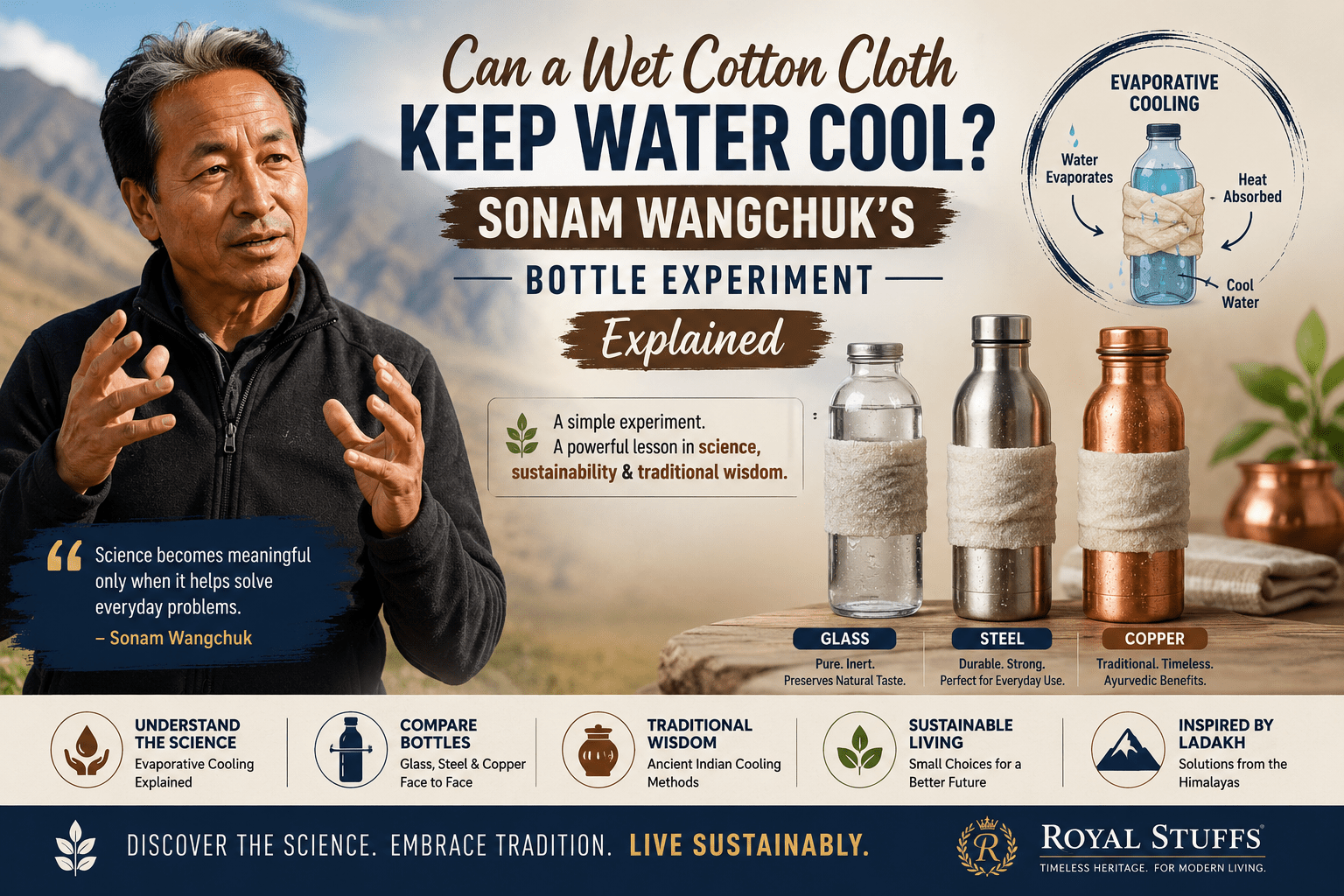
Can a Wet Cotton Cloth Keep Water Cool? | Sonam Wangchuk's Bottle Experiment Explained

(Sonam Wangchuk bottle experiment demonstrating evaporative cooling with glass, steel, and copper bottles)
Introduction
When Sonam Wangchuk shared a simple experiment using a wet cotton cloth and a few everyday water bottles, millions of people stopped scrolling and started asking questions. Could something as ordinary as a piece of cotton really keep water cool? More importantly, what was the science behind this fascinating demonstration?
The viral video wasn't just another science experiment. It was a powerful reminder that some of the most effective solutions to modern challenges don't always require expensive technology or electricity. Instead, they can be found in the natural principles that humans have understood and used for centuries.
What made the experiment even more inspiring was its timing. While observing a hunger strike to raise awareness about the environmental future of Ladakh, Sonam Wangchuk continued doing what he has dedicated his life to—teaching. Instead of delivering a long lecture, he chose a simple demonstration that anyone could understand and even try at home.
Using a wet cotton cloth wrapped around bottles made of different materials, Wangchuk explained how evaporative cooling works and why the choice of bottle material also matters. During the demonstration, he highlighted that glass is an excellent material for storing water, steel is a good conductor of heat, and copper bottles have their own unique benefits, encouraging viewers to think beyond convenience and understand the science behind everyday objects.
If you're looking for a sustainable way to stay hydrated, explore our collection of Copper Water Bottles, handcrafted by skilled artisans for everyday use.
In this article, we'll explore who Sonam Wangchuk is, why his message has inspired millions, the science behind his viral bottle experiment, and what it teaches us about sustainable living, traditional wisdom, and choosing the right water bottle for everyday hydration.
Can a wet cotton cloth really keep water cool?
Yes. Wrapping a bottle in a wet cotton cloth cools the water through evaporative cooling. As the water evaporates, it absorbs heat from the bottle's surface, naturally lowering its temperature without using electricity.
Table of Content
1. Who Is Sonam Wangchuk?
2. Why Is Sonam Wangchuk on Hunger Strike?
3. The Viral Bottle Experiment
4. What Was He Trying To Teach?
5. Can Wet Cotton Really Cool Water?
6. Science of Evaporative Cooling
7. Steel vs Glass vs Copper Bottles
8. Why Copper Bottles Are Still Relevant
9. Traditional Indian Cooling Methods
10. What We Can Learn from Sonam Wangchuk's Experiment
11. Key Takeaways
12. FAQs
13. Final Thoughts
Who Is Sonam Wangchuk? The Engineer Inspiring Sustainable Solutions

(Sonam Wangchuk speaking about sustainable innovation and natural cooling methods)
Sonam Wangchuk is one of India's most respected engineers, innovators, education reformers, and environmentalists. Born and raised in the high-altitude region of Ladakh, he has spent decades developing practical solutions to some of the toughest challenges faced by mountain communities, including water scarcity, climate change, sustainable development, and education.
Unlike many innovators who rely on expensive technology, Wangchuk believes that the best ideas are often the simplest. His work combines science, local knowledge, and traditional practices to create affordable solutions that improve people's lives while protecting the environment.
He is widely known for developing the Ice Stupa Project, an innovative artificial glacier that stores winter water as towering cones of ice. As temperatures rise during spring, the ice melts gradually, providing water to farmers when they need it most. The project has received international recognition as an innovative response to climate change and water conservation.
Beyond engineering, Wangchuk has transformed education through the Students' Educational and Cultural Movement of Ladakh (SECMOL). Instead of encouraging students to memorize facts, he promotes learning through observation, experimentation, and real-world problem solving. His philosophy is simple: science becomes meaningful only when it helps solve everyday problems.
The same philosophy of combining traditional knowledge with practical living is reflected in handcrafted Copper Water Bottles, which continue a centuries-old Indian practice of storing drinking water in reusable metal vessels.
This same philosophy is reflected in the bottle experiment that recently captured the attention of millions. Using nothing more than a wet cotton cloth and a few bottles, Wangchuk once again proved that powerful lessons don't require complicated equipment—only curiosity, scientific thinking, and a willingness to learn from nature.
Why Is Sonam Wangchuk on a Hunger Strike?
At the time his bottle experiment went viral, Sonam Wangchuk was not conducting a classroom demonstration or speaking at a scientific conference. He was participating in a hunger strike to draw attention to the environmental and constitutional concerns surrounding Ladakh.
Since Ladakh became a Union Territory in 2019, Wangchuk has been advocating for stronger constitutional safeguards to protect the region's fragile Himalayan ecosystem, unique culture, and local communities. He has repeatedly emphasized that rapid, unregulated development and the growing impacts of climate change could threaten one of the world's most ecologically sensitive landscapes. His campaign has focused on sustainable development, environmental conservation, and ensuring that local voices remain central to decisions affecting Ladakh's future.
What made this moment particularly inspiring was that, even during his protest, Wangchuk never stopped doing what he has always believed in—educating people through simple, practical science. Rather than delivering a political speech, he chose to demonstrate a basic scientific principle using a wet cotton cloth and a few everyday water bottles.
The experiment reflected the same philosophy that has guided his work for decades: meaningful change begins with understanding how nature works. Whether addressing water scarcity through the Ice Stupa Project or explaining how evaporative cooling can keep drinking water naturally cool, Wangchuk consistently shows that science is most powerful when it offers practical, sustainable solutions that everyone can understand and apply.
This is why the bottle experiment resonated with millions. It wasn't simply about cooling water—it symbolized resilience, curiosity, and the belief that even in difficult circumstances, knowledge should continue to be shared. That powerful combination of science, sustainability, and purpose transformed a simple demonstration into a lesson that reached people around the world.
The Viral Bottle Experiment That Captured Everyone's Attention

(Wet cotton cloth wrapped around glass, steel, and copper bottles)
One of the reasons Sonam Wangchuk's video spread so quickly across social media was its simplicity. There were no expensive instruments, complicated calculations, or advanced laboratory equipment—just a wet cotton cloth, water, and a few everyday bottles.
As he wrapped the bottles with the damp cotton cloth, Wangchuk explained how evaporative cooling naturally lowers temperature. When water from the cloth begins to evaporate, it absorbs heat from the surface of the bottle, making the bottle and the water inside feel cooler. It is the same natural process that cools our bodies when sweat evaporates from our skin.
During the demonstration, Wangchuk also discussed how different bottle materials behave. He explained that glass is an excellent choice because it is chemically inert and does not react with drinking water. He pointed out that steel is a good conductor of heat, allowing it to transfer heat more quickly than some other materials. He also mentioned that copper bottles have their own unique benefits, reminding viewers that each material offers different advantages depending on how it is used.
The experiment wasn't presented as a competition to determine the "best" bottle. Instead, it encouraged viewers to understand how material properties influence everyday experiences and why choosing the right bottle depends on factors such as durability, health preferences, and intended use.
More importantly, the demonstration showed that cooling water doesn't always require electricity or refrigeration. By using a simple cotton cloth and understanding the science of evaporation, anyone can experience one of nature's oldest and most energy-efficient cooling methods.
This practical, easy-to-understand demonstration resonated with millions of people because it combined science, sustainability, and traditional wisdom in a way that was both accessible and immediately useful. It also set the stage for a deeper discussion about the science behind evaporative cooling and why this centuries-old technique continues to remain relevant in today's world.
What Was Sonam Wangchuk Trying to Teach?
While many viewers focused on the cooling effect of the wet cotton cloth, Sonam Wangchuk's real message went far beyond keeping water cool. The experiment wasn't designed simply as a science lesson—it was a reminder that some of the most effective solutions to today's challenges already exist in nature. All we need is the curiosity to understand them and the wisdom to apply them.
For decades, Wangchuk has encouraged people to look at problems differently. Whether it's water scarcity in Ladakh, renewable energy, sustainable architecture, or education, his approach has always been the same: find solutions that are simple, practical, affordable, and environmentally responsible. The bottle experiment reflected this philosophy perfectly.
Science Doesn't Always Need Expensive Technology
In today's world, many people associate innovation with advanced machines, artificial intelligence, or costly equipment. Wangchuk challenged that thinking by proving that a wet cotton cloth, a little water, and basic scientific knowledge can teach an important lesson about cooling.
The experiment demonstrated that science is not limited to laboratories. It is present in everyday life—in the way we sweat, the way clothes dry under the sun, and even the way our grandparents kept drinking water cool before refrigerators became common.
His message was clear:
Understanding nature is often the first step toward solving modern problems.
Nature Is the Best Teacher
The demonstration highlighted one of nature's oldest cooling systems—evaporative cooling.
Instead of consuming electricity or relying on refrigerants, evaporation naturally removes heat from an object's surface. It's a process that has existed for millions of years and continues to work without harming the environment.
By explaining this simple principle, Wangchuk encouraged people to appreciate how natural systems can often provide sustainable alternatives to energy-intensive solutions.
Traditional Wisdom Still Has Scientific Value
One of the most interesting aspects of the experiment is that it validates practices that have existed in Indian households for generations.
Long before refrigerators became a household necessity, people kept water cool by:
-
Storing it in earthen matkas
-
Covering pots with wet cotton cloth
-
Keeping water in shaded, well-ventilated areas
-
Using natural airflow instead of artificial cooling
These weren't random traditions—they were practical solutions based on observation and experience. Modern science now explains why they work, and Wangchuk's experiment helped bridge the gap between traditional wisdom and scientific understanding.
Education Should Continue Even During Difficult Times
Perhaps the most inspiring lesson wasn't about the bottle at all—it was about the importance of sharing knowledge.
Even while participating in a hunger strike for Ladakh's environmental future, Sonam Wangchuk chose to continue teaching. Instead of allowing difficult circumstances to interrupt education, he used them as an opportunity to inspire millions with a simple yet meaningful scientific demonstration.
That reflects one of his lifelong beliefs:
Knowledge becomes truly valuable only when it helps improve people's lives.
His experiment encouraged viewers to ask questions, understand everyday science, and think more deeply about how small actions can contribute to a more sustainable future.
Ultimately, the bottle experiment wasn't just about cooling water—it was about changing the way we think. It reminded us that innovation doesn't always begin with complex technology. Sometimes, it begins with observing nature, understanding science, and applying simple ideas in our daily lives.
Can a Wet Cotton Cloth Really Keep Water Cool?
The short answer is yes—a wet cotton cloth can help keep water cooler, but not because the cloth itself has any special cooling property. The cooling effect comes from a natural scientific process called evaporative cooling, where water absorbs heat as it evaporates.
This was the central idea behind Sonam Wangchuk's bottle experiment. By wrapping a bottle with a wet cotton cloth, he demonstrated how nature can cool an object without electricity, refrigeration, or any complex technology. It's a simple technique that has been used for generations and is still effective under the right weather conditions.
How Does It Work?
When a cotton cloth is soaked in water and wrapped around a bottle, the water begins to evaporate from the cloth's surface.
As water changes from a liquid into vapor, it requires energy. Instead of generating this energy on its own, it draws heat from the bottle and the surrounding environment. As heat is removed, the bottle's surface temperature decreases, helping the water inside remain cooler.
This is exactly the same process that cools our bodies when we sweat. As sweat evaporates from our skin, it absorbs body heat, making us feel cooler. The same principle applies to the wet cloth wrapped around a water bottle.
Does It Work in Every Weather Condition?
The effectiveness of evaporative cooling depends on the surrounding environment.
It works best when:
-
The weather is hot and dry
-
There is good airflow
-
The cloth remains damp
In these conditions, water evaporates quickly, creating a noticeable cooling effect.
However, in humid weather, the air already contains a large amount of moisture. Since the air cannot absorb much more water vapor, evaporation slows down, and the cooling effect becomes much weaker.
This is why the method is particularly effective in many dry and semi-arid regions, while its performance is more limited during the monsoon season or in highly humid coastal areas.
How Much Can It Cool the Water?
Although it won't replace a refrigerator, evaporative cooling can still make a significant difference.
Under hot, dry conditions, the temperature of the water may drop by 5–15°C, depending on factors such as humidity, airflow, sunlight, and the amount of water available for evaporation.
In humid conditions, the reduction is usually much smaller because evaporation occurs more slowly.
Why Cotton Cloth?
Cotton is one of the best fabrics for this technique because it:
-
Absorbs water efficiently
-
Allows air to circulate through the fabric
-
Releases moisture gradually
-
Is reusable, biodegradable, and widely available
These qualities make cotton ideal for creating a steady evaporative cooling effect while remaining environmentally friendly.
A Simple Solution That Still Works
What makes this technique remarkable is its simplicity. With nothing more than a bottle, water, and a piece of cotton cloth, anyone can use one of nature's oldest cooling methods without consuming electricity or relying on expensive equipment.
This is exactly the lesson Sonam Wangchuk wanted people to appreciate—not every solution needs to be high-tech. Sometimes, understanding a basic scientific principle is enough to solve an everyday problem in a sustainable and practical way.
The Science Behind Evaporative Cooling

(Evaporative cooling process on a water bottle using a wet cotton cloth)
At the heart of Sonam Wangchuk's bottle experiment lies a simple yet fascinating scientific principle known as evaporative cooling. Although it may sound complex, it's a natural process that people experience every day without even realizing it. From the way our bodies cool through sweating to the refreshing chill of water stored in an earthen pot, evaporative cooling has been helping humans stay comfortable for centuries.
What Is Evaporative Cooling?
Evaporative cooling is the process in which water absorbs heat as it changes from a liquid into a gas (water vapor). This transformation requires energy, and that energy comes in the form of heat from the surrounding surface.
In Sonam Wangchuk's demonstration, the wet cotton cloth wrapped around the bottle slowly lost water through evaporation. As the water evaporated, it drew heat from the bottle's surface, causing the bottle and the water inside to become cooler.
Unlike refrigerators or air conditioners, this process doesn't require electricity or chemical refrigerants. It relies entirely on the natural behavior of water molecules.
Understanding Latent Heat of Vaporization
One of the key scientific concepts behind evaporative cooling is latent heat of vaporization.
When water changes from a liquid into vapor, it must absorb a significant amount of heat energy. Instead of increasing the water's temperature, this energy is used to break the bonds between water molecules, allowing them to escape into the air as vapor.
Because the heat is taken from the bottle and its surroundings, the surface temperature gradually decreases. This is why the bottle feels cooler to the touch after being wrapped in a wet cloth.
Although the scientific term may sound technical, the process itself is incredibly common and happens around us every day.
Why Airflow and Humidity Matter
The success of evaporative cooling depends heavily on the surrounding weather conditions.
Hot and Dry Weather
Evaporative cooling works best when:
-
The temperature is high.
-
The air is dry (low humidity).
-
There is good airflow or a gentle breeze.
Under these conditions, water evaporates quickly, allowing more heat to be removed from the bottle. This is why the method is particularly effective in many dry and semi-arid regions during summer.
Humid Weather
In humid conditions, the air already contains a large amount of moisture. Since there is less room for additional water vapor, evaporation slows down considerably.
As a result, the cooling effect becomes much weaker. This explains why wrapping a bottle in a wet cloth may provide only limited cooling during the monsoon season or in coastal regions with high humidity.
Everyday Examples of Evaporative Cooling
One reason Sonam Wangchuk's experiment resonated with so many people is that it demonstrated a scientific principle we experience almost every day.
Sweating:
When our body temperature rises, sweat forms on the skin. As it evaporates, it absorbs body heat, helping us cool down naturally.
Earthen Pots (Matkas):
Traditional clay pots have tiny pores that allow small amounts of water to seep through. As this water evaporates from the outer surface, it naturally cools the water stored inside, making matkas an energy-free alternative to refrigeration.
Desert Coolers:
Air coolers operate on the same principle. Warm air passes through water-soaked cooling pads, and as the water evaporates, the air temperature drops before it enters the room.
Wet Cloth Around a Bottle:
The method demonstrated by Sonam Wangchuk follows the same scientific process. The damp cotton cloth provides a continuous source of moisture, allowing evaporation to remove heat from the bottle's surface.
A Natural Cooling Method That Still Matters
Long before electricity became widely available, communities around the world relied on evaporative cooling to stay comfortable during hot weather. Traditional practices such as storing water in clay pots, covering containers with wet cloth, and designing homes with natural ventilation all took advantage of this remarkable scientific process.
Today, as the world looks for more sustainable and energy-efficient solutions, evaporative cooling remains just as relevant. It requires no electricity, produces no harmful emissions, and makes use of one of nature's most effective cooling mechanisms.
Sonam Wangchuk's experiment reminds us that while technology continues to evolve, some of the smartest solutions have always existed around us. By understanding the science behind evaporative cooling, we not only appreciate a fascinating natural phenomenon but also discover practical ways to reduce energy consumption and live more sustainably.
Steel vs Glass vs Copper Bottles: Understanding the Science Behind Each Material
One of the most interesting parts of Sonam Wangchuk's bottle experiment was how it encouraged people to think about something we rarely consider—the material of the bottle we use every day.
While the experiment focused on evaporative cooling, Wangchuk also explained that different materials behave differently when exposed to heat. He mentioned that glass is a good choice for storing water, steel is a good conductor of heat, and copper bottles have their own unique benefits.
If you're considering adding one to your daily routine, browse Royal Stuffs' collection of handcrafted Copper Water Bottles, designed to combine traditional craftsmanship with everyday functionality.
This naturally raises an important question:
Which bottle material is best for everyday use?
The answer depends on what you're looking for—cooling performance, durability, taste, health benefits, or sustainability.
Let's understand how each material works.
Steel Bottles
Stainless steel bottles are among the most popular choices today because they are durable, lightweight, and suitable for everyday use. They're commonly used in offices, schools, gyms, and while travelling.
One of the reasons Sonam Wangchuk referred to steel is that it is a good conductor of heat. This means heat moves through steel relatively quickly compared to materials like glass.
Advantages of Steel Bottles
-
Strong and highly durable
-
Resistant to rust and corrosion (high-quality stainless steel)
-
Lightweight and travel-friendly
-
Easy to clean and maintain
-
Long-lasting and reusable
Things to Consider
Because steel transfers heat efficiently, it also responds quickly to changes in the surrounding temperature. During Wangchuk's experiment, wrapping the bottle in a wet cotton cloth allowed evaporative cooling to remove heat from the bottle's surface. Without this natural cooling process—or insulation—a steel bottle left in direct sunlight can warm up faster than many people expect.
This is one reason insulated stainless steel bottles are popular for maintaining water temperature over longer periods.
Glass Bottles
During the demonstration, Sonam Wangchuk highlighted glass as an excellent material for storing drinking water.
Unlike metal containers, glass is chemically inert, meaning it does not react with water or alter its taste. This makes it one of the purest materials for storing beverages.
Advantages of Glass Bottles
-
Preserves the natural taste of water
-
Does not react with acidic or alkaline drinks
-
Easy to clean
-
Fully recyclable
-
Free from concerns associated with some plastic containers
Things to Consider
The biggest drawback of glass is its fragility. Although modern glass bottles are often made with thicker or borosilicate glass, they are still more likely to break if dropped.
Glass is also heavier than many reusable bottle materials, making it less convenient for outdoor activities or frequent travel.
However, for home or office use, many people prefer glass because of its purity and elegant appearance.
Copper Bottles
Copper bottles have been used in India for centuries and continue to be valued for their combination of traditional heritage, craftsmanship, and sustainability.
During his experiment, Sonam Wangchuk mentioned that copper bottles have their own benefits. While the experiment itself focused on the science of cooling rather than health, copper remains a popular material because of its long history in Indian households and Ayurvedic traditions.
Like steel, copper is also an excellent conductor of heat. This means it readily exchanges heat with its surroundings. When wrapped in a wet cotton cloth, a copper bottle participates in the same evaporative cooling process demonstrated by Wangchuk. The cooling effect comes from the evaporation of water—not from the copper itself—but copper efficiently transfers heat to its surface, where evaporation can remove it.
Advantages of Copper Bottles
-
Traditionally used in Ayurveda for storing drinking water overnight (commonly known as Tamra Jal)
-
Naturally antimicrobial copper surfaces have been widely studied for their ability to reduce certain microbes on contact
-
Durable and long-lasting with proper care
-
Fully recyclable and environmentally friendly
-
Elegant handcrafted appearance that blends tradition with modern living
Things to Consider
Copper bottles require regular cleaning to maintain their shine and should generally be used for storing plain drinking water rather than acidic beverages like lemon juice or soft drinks, which can react with the metal.
With proper care, a quality copper bottle can remain a reliable companion for years while also reducing dependence on single-use plastic bottles.
Steel vs Glass vs Copper: A Quick Comparison
|
Feature |
Steel |
Glass |
Copper |
|
Durability |
★★★★★ |
★★☆☆☆ |
★★★★☆ |
|
Break Resistance |
Excellent |
Low |
Very Good |
|
Heat Conductivity |
High |
Lower |
High |
|
Taste Preservation |
Good |
Excellent |
Traditionally valued |
|
Sustainability |
Excellent |
Excellent |
Excellent |
|
Traditional Heritage |
Moderate |
Moderate |
Strong |
|
Best For |
Travel & Daily Use |
Home & Office |
Everyday Wellness & Traditional Use |
|
Myth |
Fact |
|
Copper cools water by itself |
Evaporation causes the cooling |
|
Only copper works |
Steel, glass, clay, and copper all work |
|
It replaces a fridge |
It cools naturally but doesn't refrigerate |
|
Wet cloth always works |
It's most effective in hot, dry conditions |
Which Bottle Should You Choose?
There isn't a single "best" bottle for everyone.
If you need a lightweight and durable bottle for travel, stainless steel is a practical choice.
If preserving the natural taste of water is your priority, glass bottles are an excellent option.
If you appreciate traditional craftsmanship, sustainable living, and the long-standing practice of storing water in copper vessels, a handcrafted copper bottle offers a unique combination of heritage and everyday functionality.
Rather than declaring one material superior, Sonam Wangchuk's experiment encourages us to understand the science behind each one. Every material has its own strengths, and choosing the right bottle depends on your lifestyle, preferences, and intended use.

(Comparison of glass, stainless steel, and copper water bottles)
What Makes Copper Bottles Different Beyond Cooling?
While Sonam Wangchuk's experiment demonstrated the science of evaporative cooling, it also reminded many people about the importance of choosing the right material for everyday use. Among the materials he mentioned, copper holds a unique place because its value extends far beyond its thermal properties.
Unlike glass, which is prized for being chemically inert, or stainless steel, which is known for its strength and durability, copper has been an integral part of Indian households for thousands of years. It represents a blend of traditional wisdom, skilled craftsmanship, sustainability, and conscious living.
A Tradition Rooted in Indian Heritage
Long before modern water purifiers and reusable bottles became popular, storing drinking water in copper vessels was a common practice across India.
Ancient Ayurvedic texts describe the practice of storing water overnight in a copper vessel, often referred to as Tamra Jal. Want to learn more? Read our complete guide on Benefits of Drinking Water from a Copper Bottle, where we explore its traditional significance, care tips, and everyday use. This traditional practice has been followed in many homes for generations and continues to be appreciated by people who value natural and mindful living.
Today, handcrafted copper bottles carry forward this centuries-old tradition while offering a practical alternative to disposable plastic bottles.
Naturally Antimicrobial Properties
One of the most widely studied characteristics of copper is its natural antimicrobial surface.
Scientific research has shown that copper surfaces can reduce the survival of many types of bacteria and other microorganisms over time. This property has led to the use of copper alloys in hospitals, public buildings, and healthcare settings where hygiene is especially important.
While this doesn't replace proper cleaning or safe drinking water practices, it is one of the reasons copper continues to attract scientific interest alongside its traditional reputation.
A Sustainable Choice for Everyday Hydration
As awareness about plastic pollution continues to grow, more people are choosing reusable bottles that are durable and environmentally responsible.
Copper bottles offer several sustainability benefits:
-
Built to last for many years with proper care
-
Fully recyclable without losing material quality
-
Reduce dependence on single-use plastic bottles
-
Support traditional Indian metal craftsmanship and artisan communities
Choosing a reusable copper bottle is not only a personal lifestyle decision but also a small step toward reducing environmental waste.
Beauty That Improves with Time
Unlike many modern materials, copper develops a natural patina as it ages. Some people prefer polishing their bottles to maintain a bright finish, while others appreciate the rich antique appearance that develops naturally over time.
This evolving character makes every copper bottle unique. Rather than simply being a water container, it often becomes a piece of functional craftsmanship that reflects India's rich metalworking heritage.
Caring for a Copper Bottle
Proper care helps preserve both the appearance and performance of a copper bottle.
Some simple maintenance tips include:
-
Clean the bottle regularly using lemon and salt or a natural copper cleaner.
-
Rinse thoroughly after cleaning and allow it to dry completely.
-
Store only plain drinking water unless the manufacturer recommends otherwise.
-
Avoid acidic beverages such as lemon water, vinegar-based drinks, soft drinks, or fruit juices, as these can react with copper.
With routine care, a quality copper bottle can remain beautiful and functional for many years.
More Than Just a Bottle
What makes copper special isn't that it cools water better than other materials—it doesn't. As Sonam Wangchuk's experiment demonstrated, the cooling effect comes from evaporative cooling, not from the bottle material itself.
The true value of copper lies elsewhere. It combines centuries of Indian tradition, sustainable craftsmanship, durability, and a timeless aesthetic into an everyday object that people continue to value across generations.
For those looking to embrace a more mindful and eco-friendly lifestyle, a handcrafted copper bottle represents more than hydration—it reflects an appreciation for heritage, quality, and conscious living.
Traditional Indian Cooling Methods That Still Work Today

(Traditional Indian cooling methods using matka, surahi, and copper vessels)
Long before refrigerators, air conditioners, and insulated bottles became a part of daily life, Indian households relied on simple yet remarkably effective methods to stay cool during the scorching summer months. These practices weren't based on advanced technology—they were based on a deep understanding of nature, climate, and everyday science.
Sonam Wangchuk's bottle experiment is a perfect example of this timeless wisdom. By wrapping a bottle in a wet cotton cloth, he demonstrated the same principle that generations of Indians have unknowingly used for centuries: working with nature instead of against it.
Many of these traditional cooling techniques are still relevant today, especially for those looking to reduce electricity consumption and adopt a more sustainable lifestyle.
1. Earthen Pots (Matkas)
Perhaps the most iconic Indian cooling method is storing drinking water in a matka or clay pot.
Because clay is naturally porous, tiny amounts of water slowly seep through its surface and evaporate into the surrounding air. This evaporation removes heat from the pot, naturally cooling the water inside without any electricity.
Even today, many households prefer matka water because it remains pleasantly cool and has a refreshing taste during summer.
2. Wet Cotton Cloth Around Water Containers
The technique demonstrated by Sonam Wangchuk has been practiced in Indian homes for decades.
Before refrigerators became common, people often wrapped water vessels in a wet cotton cloth and placed them in a shaded, well-ventilated area. As the water in the cloth evaporated, it drew heat away from the container, helping keep the drinking water cooler for longer.
This simple, low-cost method continues to be useful during hot and dry weather.
3. Surahi – The Traditional Clay Water Jug
A surahi is a traditional clay water jug with a narrow neck and porous walls.
Like a matka, it cools water naturally through evaporation. Its unique shape also helps reduce dust contamination while allowing water to stay cool for extended periods.
For centuries, surahis have been used across many parts of India as an elegant and eco-friendly way to store drinking water.
4. Khus (Vetiver) Curtains
Before modern air coolers became popular, many homes used khus curtains, made from fragrant vetiver grass.
These curtains were hung over windows and kept damp with water. As warm air passed through the wet grass, evaporation cooled the incoming air while the natural aroma of vetiver created a fresh and pleasant indoor environment.
The same scientific principle is used in modern desert coolers today.
5. Naturally Ventilated Homes
Traditional Indian architecture was designed with the local climate in mind.
Features such as:
-
Thick walls
-
High ceilings
-
Inner courtyards
-
Verandas
-
Jali (lattice) windows
-
Cross ventilation
helped reduce indoor temperatures naturally by improving airflow and minimizing direct heat gain.
These passive cooling techniques remain an inspiration for sustainable architecture around the world.
6. Copper and Brass Water Vessels
Alongside clay pots, many Indian families traditionally stored drinking water in copper and brass vessels.
While these metals do not cool water on their own like earthenware, they have long been valued for their durability, reusability, and cultural significance. Copper vessels, in particular, are associated with the Ayurvedic practice of storing water overnight, while brass utensils have been used for generations in Indian kitchens.
Today, handcrafted copper and brass bottles continue this legacy by offering an eco-friendly alternative to disposable plastic bottles.
Ancient Wisdom Meets Modern Science
What makes these traditional practices remarkable is that modern science now explains why many of them work so well.
Whether it's:
-
Water cooling naturally inside a clay pot,
-
Air becoming cooler as it passes through wet khus curtains,
-
Or a bottle wrapped in a damp cotton cloth,
the underlying principle remains the same—evaporative cooling.
This is exactly what Sonam Wangchuk demonstrated in his viral experiment. Instead of introducing a new invention, he reminded us that some of the smartest and most sustainable solutions have always existed around us.
As the world searches for environmentally friendly ways to reduce energy consumption, these traditional Indian cooling methods continue to prove that innovation isn't always about creating something new. Sometimes, it's about rediscovering the wisdom that has been with us all along.
Today, many households continue this tradition with handcrafted Copper Water Bottles and Brass Water Bottles, offering a sustainable alternative to disposable plastic bottles.
What We Can Learn from Sonam Wangchuk's Experiment

(Sustainable living with reusable water bottles and traditional Indian practices)
At first glance, Sonam Wangchuk's bottle experiment appears to be a simple science demonstration. A bottle, a wet cotton cloth, and a little water don't seem like much. Yet this small experiment carries a powerful message that extends far beyond cooling drinking water.
It reminds us that some of the most effective solutions to modern challenges are often rooted in nature, science, and traditional wisdom.
Small Ideas Can Create Big Impact
In a world driven by advanced technology and expensive innovations, it's easy to overlook simple solutions. Wangchuk's demonstration shows that understanding basic scientific principles can sometimes solve everyday problems more sustainably than relying solely on machines.
A damp cloth cooling a bottle may seem ordinary, but it demonstrates how observing nature can inspire practical, low-cost, and energy-efficient solutions.
Sustainability Starts with Everyday Choices
Climate change and rising energy consumption are global concerns, but meaningful change often begins with small daily decisions.
Choosing to:
-
Carry a reusable water bottle instead of buying single-use plastic bottles
-
Understand natural cooling methods before relying on electricity
-
Respect traditional knowledge alongside modern science
-
Reduce unnecessary energy consumption whenever possible
Choosing durable products like handcrafted Brass Kitchenware and reusable metal bottles is another simple way to embrace a more sustainable lifestyle.
are all examples of how individuals can contribute to a more sustainable future.
Sonam Wangchuk's experiment encourages us to think beyond convenience and consider the environmental impact of our everyday habits.
Traditional Knowledge Still Has Value
For generations, Indian households practiced methods such as storing water in matkas, using wet cloths to cool containers, designing naturally ventilated homes, and preserving water in traditional metal vessels.
Modern science now explains why many of these practices work so effectively.
Rather than dismissing traditional wisdom as outdated, Wangchuk's demonstration reminds us that many ancestral practices were based on careful observation of nature and practical experience.
Innovation Doesn't Always Mean Complexity
One of the biggest lessons from the experiment is that innovation isn't always about creating something entirely new.
Sometimes, innovation means:
-
Looking at old ideas with fresh understanding.
-
Applying scientific knowledge to everyday life.
-
Finding sustainable alternatives to resource-intensive solutions.
-
Making simple concepts accessible to everyone.
This philosophy has guided much of Sonam Wangchuk's work—from education reforms to environmental initiatives—and is clearly reflected in this demonstration.
A Reminder to Live More Mindfully
Whether you choose a glass bottle, a stainless steel bottle, or a handcrafted copper bottle, the experiment encourages one important habit: be more conscious of the choices you make every day.
Understanding the science behind everyday objects helps us become more informed consumers, while appreciating traditional practices reminds us that sustainability is often about balance rather than complexity.
Ultimately, Sonam Wangchuk's bottle experiment is not just about cooling water. It is a lesson in curiosity, environmental responsibility, and the power of simple scientific thinking.
As we face growing environmental challenges, perhaps the greatest takeaway is this:
The smartest solutions are not always the most complicated. Sometimes, they are the ones that have quietly existed around us for generations—waiting to be understood, appreciated, and used once again.
Key Takeaways
If you're short on time, here are the most important lessons from Sonam Wangchuk's bottle experiment:
-
A wet cotton cloth can naturally cool water through evaporative cooling. As water evaporates from the cloth, it absorbs heat from the bottle's surface, reducing its temperature without electricity.
-
The cooling effect comes from evaporation—not from the bottle material itself. Whether you use a glass, steel, or copper bottle, the principle remains the same.
-
Evaporative cooling works best in hot, dry, and well-ventilated conditions. In humid weather, the cooling effect is less noticeable because evaporation slows down.
-
Every bottle material has its own strengths. Glass preserves the natural taste of water, stainless steel offers durability and portability, while copper is valued for its traditional heritage, sustainability, and long-standing use in Indian households.
-
Traditional Indian cooling methods are supported by science. Practices such as storing water in clay pots, wrapping containers in wet cotton cloth, and using naturally ventilated spaces all rely on the same scientific principle of evaporative cooling.
-
Sustainability often begins with simple everyday choices. Reusing durable water bottles, understanding natural cooling methods, and reducing unnecessary energy consumption are practical steps toward a more environmentally responsible lifestyle.
-
Sonam Wangchuk's experiment reminds us that innovation doesn't always require advanced technology. Sometimes, the most effective solutions come from observing nature, applying basic scientific principles, and rediscovering traditional wisdom.
Whether you're interested in the science of cooling, sustainable living, or choosing the right water bottle, this experiment demonstrates that simple ideas can still have a powerful impact in today's world.
Frequently Asked Questions (FAQs)
1. What was Sonam Wangchuk's bottle experiment about?
Sonam Wangchuk demonstrated how wrapping a bottle with a wet cotton cloth can naturally cool the water inside through evaporative cooling. The experiment highlighted a simple scientific principle that has been used for centuries and emphasized sustainable, nature-based solutions instead of relying solely on modern technology.
2. Does wrapping a bottle in a wet cloth really keep water cool?
Yes. As the water in the wet cloth evaporates, it absorbs heat from the bottle's surface, reducing its temperature. This process is called evaporative cooling and works best in hot, dry, and well-ventilated conditions.
3. Why does evaporative cooling work better in dry weather?
Dry air can absorb more water vapor, allowing evaporation to happen more quickly. Faster evaporation removes more heat from the bottle, creating a stronger cooling effect. In humid weather, evaporation slows down, so the cooling effect is less noticeable.
4. Which bottle material is better—steel, glass, or copper?
Each material has its own advantages:
-
Glass preserves the natural taste of water because it is chemically inert.
-
Stainless steel is durable, lightweight, and ideal for everyday use.
-
Copper is valued for its traditional significance, sustainability, and long history of use in Indian households.
The best choice depends on your personal preferences and intended use.
5. Did Sonam Wangchuk recommend using copper bottles?
No. In his demonstration, Sonam Wangchuk explained the characteristics of different bottle materials. He noted that glass is an excellent material for storing water, steel is a good conductor of heat, and copper bottles have their own benefits. The experiment focused on the science of evaporative cooling rather than recommending one bottle material over another.
6. What is Tamra Jal?
Tamra Jal refers to drinking water stored overnight in a copper vessel. This traditional Ayurvedic practice has been followed in India for centuries and remains popular among people who appreciate traditional wellness practices.
7. Can I use a wet cotton cloth on a copper bottle?
Yes. Wrapping a copper bottle in a wet cotton cloth can help cool the bottle through evaporative cooling, just as it does with steel or glass bottles. The cooling effect comes from the evaporation of water, not from the copper itself.
8. Are copper bottles environmentally friendly?
Yes. Copper bottles are reusable, durable, and fully recyclable. By replacing single-use plastic bottles with a long-lasting copper bottle, you can reduce plastic waste and make a more sustainable choice.
9. How should I clean a copper bottle?
Clean your copper bottle regularly using natural ingredients such as lemon and salt or a copper cleaner recommended by the manufacturer. Rinse it thoroughly and allow it to dry completely before reuse. Avoid storing acidic beverages in copper bottles unless specified by the manufacturer.
10. Are traditional Indian cooling methods still useful today?
Absolutely. Traditional methods such as storing water in matkas (earthen pots), using wet cotton cloths, surahis, and khus curtains are based on scientific principles like evaporative cooling. These methods continue to provide sustainable and energy-efficient ways to stay cool.
11. Can evaporative cooling replace a refrigerator?
No. Evaporative cooling can lower the temperature of water naturally, but it cannot achieve the low temperatures provided by a refrigerator. It is best viewed as an eco-friendly way to keep water pleasantly cool, especially in hot and dry climates.
12. Where can I buy handcrafted copper water bottles?
If you're looking for premium handcrafted copper bottles inspired by India's rich metalworking heritage, Explore Royal Stuffs' collection of handcrafted Copper Water Bottles, crafted in Moradabad using traditional Indian metalworking techniques. Each bottle is crafted with attention to quality, durability, and timeless design, making it a practical and sustainable choice for everyday hydration.

(Handcrafted copper water bottle representing sustainable hydration and Indian craftsmanship)
Final Thoughts
Sonam Wangchuk's bottle experiment reminds us that some of the most powerful ideas are often the simplest. With nothing more than a bottle, a wet cotton cloth, and an understanding of basic science, he demonstrated how nature itself can provide practical solutions to everyday challenges.
The experiment wasn't just about cooling water—it was about changing the way we think. It encouraged us to appreciate the science behind traditional practices, adopt sustainable habits, and recognize that innovation doesn't always require expensive technology. Sometimes, the best solutions have existed for generations, quietly waiting to be rediscovered.
Whether it's storing water in a clay matka, wrapping a bottle in a damp cotton cloth, or choosing a reusable glass, steel, or copper bottle, every small decision contributes to a more conscious and environmentally responsible lifestyle.
For those who appreciate India's rich tradition of handcrafted metalware, Royal Stuffs offers a thoughtfully curated collection of premium copper water bottles, handcrafted by skilled artisans in Moradabad. Designed for durability, sustainability, and timeless elegance, these bottles reflect the same values of quality and mindful living that have been part of Indian heritage for centuries.
If Sonam Wangchuk's experiment has inspired you to embrace sustainable living, explore Royal Stuffs' handcrafted collection of Copper Water Bottles, Brass Water Bottles, and traditional Brass Kitchenware. Each product is crafted by skilled artisans in Moradabad and reflects India's rich heritage of quality craftsmanship and mindful living.
As Sonam Wangchuk's demonstration beautifully illustrates, true progress isn't always about creating something new—it is often about understanding nature, respecting traditional wisdom, and applying simple scientific principles to live better every day.
Sometimes, the smartest innovation is simply rediscovering what nature has always been teaching us.
Related Articles
Read more
Kansa vs Bronze: Are They the Same? Complete Comparison Guide
Confused about Kansa and bronze? Learn the difference between Kansa vs bronze, understand how they are related, and discover why handcrafted Kansa Dinner Sets remain a timeless choice.
Read more