

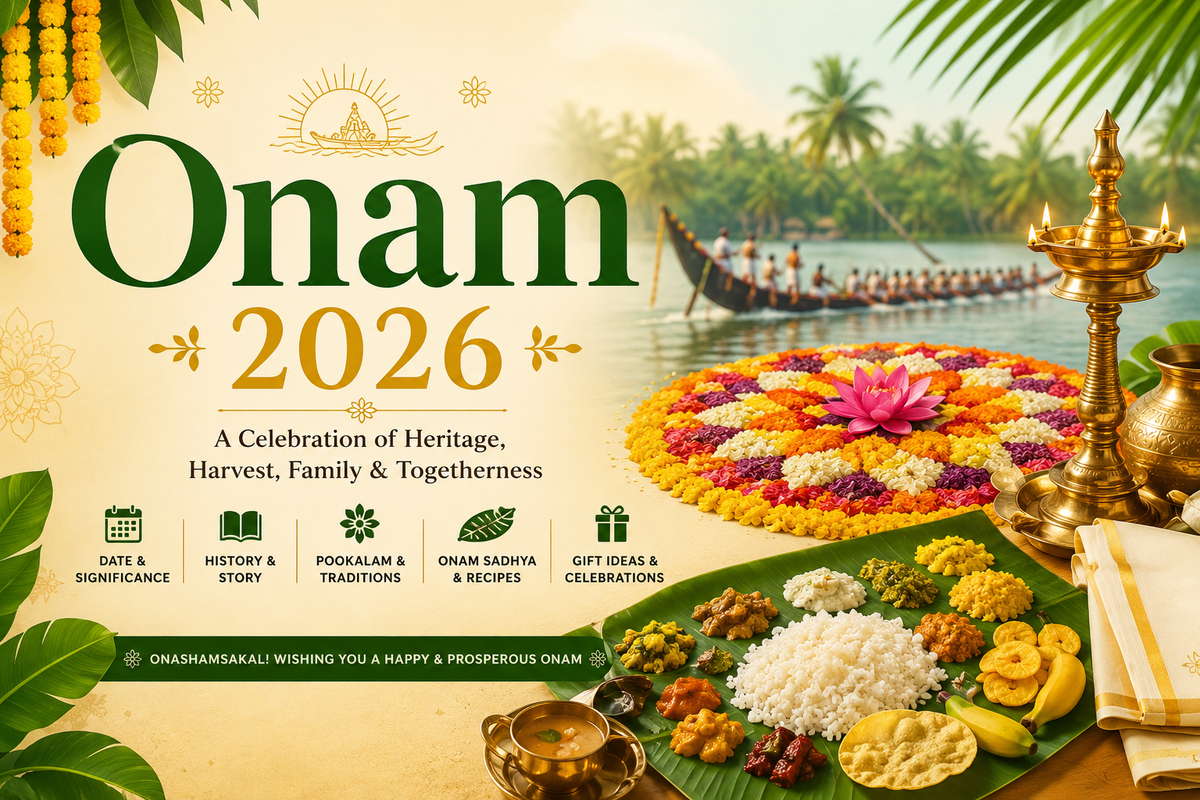
Onam 2026: Date, History, Onam Sadhya, Pookalam & Traditional Celebrations
Onam is more than a festival on Kerala's calendar. It is a celebration of abundance, family, hospitality, nature and cultural heritage. Every year, homes across Kerala come alive with colourful Pookalam, traditional clothing, music, dance, festive games and the grand Onam Sadhya served on banana leaves.
In 2026, Thiruvonam, the most important day of Onam, falls on Wednesday, August 26. Kerala Tourism lists Thiruvonam as a traditional festival celebrated across the state, while the Kerala Government's official 2026 calendar also observes August 26 as Thiruvonam.
Onam is traditionally observed over ten days, beginning with Atham and reaching its grand culmination on Thiruvonam. The festival is deeply associated with the legendary King Mahabali and the belief that he returns to visit his people during Onam.
Whether you celebrate in Kerala, another part of India or anywhere around the world, Onam offers a beautiful reminder that festivals are ultimately about sharing prosperity and bringing people together.
Table of Contents
-
When Is Onam 2026?
-
What Is Onam?
-
History and Story of Onam
-
Why Is Onam Celebrated?
-
The 10 Days of Onam
-
Traditional Onam Rituals and Celebrations
-
What Is Pookalam?
-
Onam Sadhya: The Grand Festive Feast
-
Traditional Onam Decorations
-
Traditional Onam Clothing
-
Onam Games and Cultural Traditions
-
Traditional Onam Gift Ideas
-
How to Celebrate a Traditional Onam at Home
-
Why Onam Still Matters Today
-
Frequently Asked Questions
When Is Onam 2026?

(King Mahabali welcomed by families in a traditional Kerala courtyard during Onam 2026, surrounded by Pookalam, brass lamps, flowers and lush tropical greenery.)
Onam 2026 culminates with Thiruvonam on Wednesday, August 26, 2026.
The main dates to remember are:
| Occasion | Date | Significance |
|---|---|---|
| Atham | August 17, 2026 | Beginning of the traditional 10-day Onam celebration |
| First Onam | August 25, 2026 | Festive preparations reach their peak |
| Thiruvonam | August 26, 2026 | Main and most significant day of Onam |
| Third Onam | August 27, 2026 | Continued festive celebrations |
| Fourth Onam | August 28, 2026 | Extended celebrations in Kerala |
Kerala's official 2026 government calendar lists First Onam on August 25, Thiruvonam on August 26, Third Onam on August 27 and Fourth Onam on August 28.
The exact observance of religious rituals can vary by region and family tradition.
What Is Onam?

(Thiruvonam 2026 calendar showing August 26 in a traditional Kerala home decorated with Pookalam, marigold garlands, banana leaves and brass lamps.)
Onam is one of Kerala's most important annual festivals and is closely connected with the Malayalam month of Chingam, which marks an important period in the traditional Malayalam calendar.
The festival combines cultural, agricultural and spiritual traditions. Homes are cleaned and decorated, flowers are arranged into elaborate Pookalam designs, families prepare festive meals and communities come together for cultural events.
The heart of Onam is the idea of abundance and equality.
The traditional story centres on King Mahabali, a beloved ruler remembered for his generosity and just rule. Onam is associated with his annual return to Kerala to visit his people.
History and Story of Onam
The story of Onam is traditionally connected with King Mahabali and Lord Vishnu's Vamana avatar.
According to the popular legend, Mahabali was a powerful and generous ruler whose kingdom was known for prosperity and equality. His growing influence eventually concerned the gods.
Lord Vishnu appeared before Mahabali in the form of Vamana, a dwarf Brahmin, and asked for as much land as he could cover in three steps.
Mahabali agreed.
Vamana then expanded into a cosmic form. With the first step, he covered the earth; with the second, he covered the heavens. When there was nowhere left for the third step, Mahabali offered his own head.
The story is remembered as an example of humility, generosity and devotion.
According to tradition, Mahabali was granted permission to return to his kingdom once every year. Onam celebrates this homecoming.
That is why the festival is not simply about rituals. It represents the emotional connection between a ruler and his people and the values of prosperity, generosity and togetherness.
Why Is Onam Celebrated?
Onam is celebrated for several interconnected reasons.
1. To Welcome King Mahabali
The most popular tradition associates Onam with Mahabali's annual return.
Families decorate their homes and prepare festive meals as a symbolic welcome.
2. To Celebrate Prosperity
Onam is associated with abundance and the agricultural cycle of Kerala.
The festival coincides with an important period in Kerala's traditional seasonal calendar and has strong connections with harvest and prosperity.
3. To Preserve Kerala's Culture
From Pookalam and traditional clothing to Vallam Kali, Pulikali, music and Sadhya, Onam brings together many aspects of Kerala's cultural heritage.
4. To Bring Families Together
Perhaps the most universal meaning of Onam is togetherness.
Families gather for meals, exchange gifts, participate in traditions and spend time together.
The 10 Days of Onam
Onam traditionally develops over a ten-day period beginning with Atham and ending with Thiruvonam.
During these days, Pookalam designs gradually become larger and more elaborate.
Families also prepare their homes, purchase festive items, plan meals and participate in cultural activities.
The progression from a simple beginning to the grand celebration of Thiruvonam reflects the growing excitement of the festival.
Traditional Onam Rituals and Celebrations
Onam traditions vary across Kerala, but several customs are especially well known.
Pookalam
A colourful floral arrangement is created at the entrance of the home.
Onam Sadhya
A large vegetarian feast is prepared and traditionally served on a banana leaf.
Traditional Dress
Women often wear Kerala sarees or Kasavu sarees, while men may wear traditional mundu.
Vallam Kali
The famous snake boat races are among Kerala's most spectacular Onam-associated traditions.
Pulikali
In some parts of Kerala, especially Thrissur, performers participate in the colourful tiger dance known as Pulikali. Kerala Tourism lists Pulikali among the events associated with the 2026 Onam season.
Cultural Performances
Music, dance, traditional games and community events form an important part of Onam celebrations.
What Is Pookalam?

(Traditional Onam Pookalam made with colorful fresh flowers at the entrance of a Kerala home, decorated with a brass oil lamp, banana leaves and tropical greenery.)
Pookalam is one of the most recognisable symbols of Onam.
The word refers to a decorative arrangement made using flowers. Families traditionally create Pookalam at the entrance of their homes to welcome guests and celebrate the festive spirit.
The arrangement develops throughout the ten days of Onam. As the festival approaches Thiruvonam, the designs traditionally become larger and more elaborate. Contemporary celebrations may feature geometric patterns, floral motifs and artistic designs.
Pookalam represents more than decoration. It reflects creativity, nature and the joy of preparing the home for the festival.
For a traditional celebration, you can create a Pookalam using seasonal flowers and natural materials rather than artificial decorations.
Onam Sadhya: The Grand Festive Feast

(Traditional Onam Sadhya served on a banana leaf with rice, Kerala vegetarian dishes, payasam, banana chips and papad, accompanied by brass serving bowls and a brass tumbler.)
No discussion of Onam is complete without Onam Sadhya.
Sadhya is a traditional vegetarian feast served during Onam. It is usually presented on a banana leaf with multiple dishes arranged in a customary order.
Depending on the household and region, a Sadhya may include:
-
Rice
-
Sambar
-
Avial
-
Thoran
-
Olan
-
Kalan
-
Pachadi
-
Kichadi
-
Parippu
-
Pickles
-
Banana chips
-
Pappadam
-
Payasam
The feast is designed around variety, balance and abundance.
Recent descriptions of traditional Onam Sadhya commonly feature numerous vegetarian preparations and payasam as an important dessert component.
Serving Sadhya Traditionally
Traditionally, Sadhya is served on a banana leaf, with dishes arranged in a customary manner.
For a more traditional dining experience at home, consider pairing the meal with beautiful Indian serveware.
A handcrafted brass dinnerware set can add a heritage-inspired touch to festive dining while connecting modern celebrations with traditional Indian craftsmanship.
You can explore Royal Stuffs' Brass Dinnerware Collection for traditional dining pieces suitable for festive occasions.
Traditional Onam Decorations

(Traditional Kerala home decorated for Onam with a colorful Pookalam, brass diyas, flower-filled brass urns, marigold garlands, banana leaves and warm heritage interiors.)
Onam decorations are generally colourful, natural and welcoming.
Some ideas include:
Floral Pookalam
Make the entrance the centre of attention with a traditional floral arrangement.
Traditional Lamps
Place decorative lamps around the entrance or dining area to create a warm festive atmosphere.
Brass Décor
Brass objects can complement the warm tones of flowers, wood and traditional textiles.
A brass urli, diya or decorative accent can be used as part of a traditional festive display.
Explore the Brass Home Décor Collection for heritage-inspired décor pieces.
Natural Materials
Use flowers, banana leaves, coconut leaves, jute, cotton and other natural materials wherever possible.
Traditional Onam Clothing

(Kerala family celebrating Onam in traditional Kasavu saree and white mundu, surrounded by Pookalam, brass lamps, flowers and tropical greenery.)
Traditional clothing is an important part of the festive atmosphere.
Women often wear the elegant Kasavu saree, known for its off-white or cream fabric and traditional golden border.
Men commonly wear the mundu, often paired with a simple traditional shirt or kurta.
Wearing traditional clothing during Onam is more than a fashion choice. It is a way of keeping regional heritage visible during one of Kerala's most important celebrations.
Onam Games and Cultural Traditions

(Vallam Kali snake boat race during Onam in Kerala, with synchronized rowers racing through the backwaters, colorful parasols, cheering spectators, coconut palms and traditional Kerala homes.)
Onam is also a festival of community entertainment.
Depending on the region, celebrations can include:
-
Vallam Kali
-
Pulikali
-
Traditional dances
-
Folk performances
-
Community games
-
Music
-
Cultural processions
-
Onam competitions
These activities demonstrate how Onam brings together food, art, sport, music and community.
Kerala's 2026 festival calendar includes Thiruvonam across the state along with associated cultural events such as Pulikali and the Aranmula Boat Race.
Traditional Onam Gift Ideas

(Traditional Onam gifts featuring handcrafted brass dinnerware, brass diya, brass bowl, decorative brassware and an elegant cream-and-gold gift box with fresh flowers and banana leaves.)
Gift-giving during festivals is a meaningful way to express appreciation and strengthen relationships.
For Onam, choose gifts that reflect Kerala's cultural spirit, usefulness and craftsmanship.
1. Traditional Brassware
Brass décor and dining pieces can make thoughtful heritage-inspired gifts.
2. Brass Dinnerware
A brass bowl, plate or serving piece can be especially appropriate for someone who enjoys traditional dining.
3. Decorative Brass Pieces
For a home-focused gift, consider a brass diya, urli or decorative accent.
4. Traditional Kitchenware
For families who appreciate Indian cooking traditions, traditional cookware can be both useful and meaningful.
Explore the Brass Cookware Collection for festive gifting and traditional kitchen pieces.
5. Festive Dining Sets
For a larger family gift, a traditional dining set can become part of future celebrations rather than a one-time present.
How to Celebrate a Traditional Onam at Home

(Indian family celebrating Onam together at home with a traditional Sadhya served on banana leaves, surrounded by Pookalam, brass lamps, flowers and Kerala-style festive décor.)
You don't need to live in Kerala to create a meaningful Onam celebration.
Try this simple approach:
Step 1: Clean and Prepare the Home
Begin by creating a clean and welcoming space.
Step 2: Create a Pookalam
Use fresh flowers to create a small floral design near the entrance.
Step 3: Dress Traditionally
Wear a traditional Indian outfit to make the occasion feel special.
Step 4: Prepare an Onam Sadhya
You don't need to prepare every dish. Even a smaller selection of traditional vegetarian dishes can create the spirit of Sadhya.
Step 5: Set a Traditional Dining Table
Use natural leaves, traditional serveware and heritage-inspired décor.
Step 6: Share Gifts
Choose meaningful gifts for parents, friends, relatives or colleagues.
Step 7: Learn the Story
Share the story of Mahabali with children and younger family members.
This turns Onam from a decoration-and-food event into a celebration of cultural heritage.
Why Onam Still Matters Today
Modern life is fast-paced. Families often live in different cities, work schedules are demanding and traditional practices can gradually become less visible.
Festivals such as Onam create a reason to pause.
A floral arrangement brings nature into the home.
A shared meal brings people around the same table.
Traditional clothing reconnects people with regional heritage.
A handmade object carries the story of craftsmanship.
And a family gathering creates memories that last beyond the festival itself.
That is perhaps why Onam continues to remain meaningful across generations.
The festival may evolve, but its central ideas — generosity, prosperity, equality, hospitality and togetherness — remain relevant.
Onam 2026 Celebration Checklist
Before Thiruvonam, you can prepare:
-
Fresh flowers for Pookalam
-
Traditional clothing
-
Ingredients for Sadhya
-
Banana leaves for serving
-
Traditional décor
-
Lamps and diyas
-
Festive gifts
-
Brass or traditional serveware
-
Music and cultural activities
-
Space for family and guests
Frequently Asked Questions About Onam 2026
When is Onam 2026?
The main Onam day, Thiruvonam, falls on Wednesday, August 26, 2026.
How many days is Onam celebrated?
Traditional Onam celebrations are observed over ten days, beginning with Atham and culminating in Thiruvonam.
What is the story behind Onam?
Onam is traditionally associated with the annual return of King Mahabali, a legendary ruler remembered for his generosity and just rule.
What is Pookalam?
Pookalam is a decorative floral arrangement traditionally created at the entrance of homes during Onam. The designs generally grow more elaborate as the festival progresses.
What is Onam Sadhya?
Onam Sadhya is a traditional vegetarian feast featuring rice, curries, vegetables, pickles, snacks and desserts such as payasam, traditionally served on a banana leaf.
What should I gift for Onam?
Traditional gifts such as brass décor, brass dinnerware, serving pieces, cookware and other handcrafted Indian products can make meaningful Onam gifts.
Why is Onam important in Kerala?
Onam is important because it brings together Kerala's cultural traditions, family celebrations, food, art, community activities and the story of King Mahabali.
Is Onam only celebrated in Kerala?
Kerala is the heartland of Onam, but Malayali communities across India and around the world celebrate the festival as well.

(Kerala family celebrating Onam at sunset in a traditional courtyard with a colourful Pookalam, glowing brass diyas, flower-filled brass urli, banana plants and festive decorations.)
Celebrate Onam with Tradition
Onam is a festival where food becomes a celebration, flowers become art and a simple family gathering becomes a treasured memory.
As Onam 2026 approaches, bring a little of that spirit into your own home. Create a Pookalam, prepare a festive Sadhya, wear traditional clothing, share something meaningful with loved ones and make space for the traditions that connect generations.
For those who appreciate India's rich craft heritage, traditional brassware can add another layer of warmth to the celebration — whether used for festive dining, home décor or thoughtful gifting.
Explore Royal Stuffs' collections of brass cookware, brass dinnerware and brass home décor to bring handcrafted Indian tradition to your festive celebrations.
Happy Onam 2026 — Onashamsakal!
Read more
Raksha Bandhan 2026: Date, Rituals, Gift Ideas & Interactive Quiz
Celebrate Raksha Bandhan 2026 with our complete guide featuring the festival date, auspicious muhurat, meaningful rituals, popular legends, thoughtful gift ideas, festive home décor inspiration, an...
Read more
Janmashtami 2026: Date, Krishna Story, Puja Vidhi, Fasting & Celebrations
Discover Janmashtami 2026 with its date, Krishna's birth story, Puja Vidhi, fasting traditions, Nishita Kaal, Dahi Handi, bhog and meaningful celebration ideas for home.
Read more